
Picking
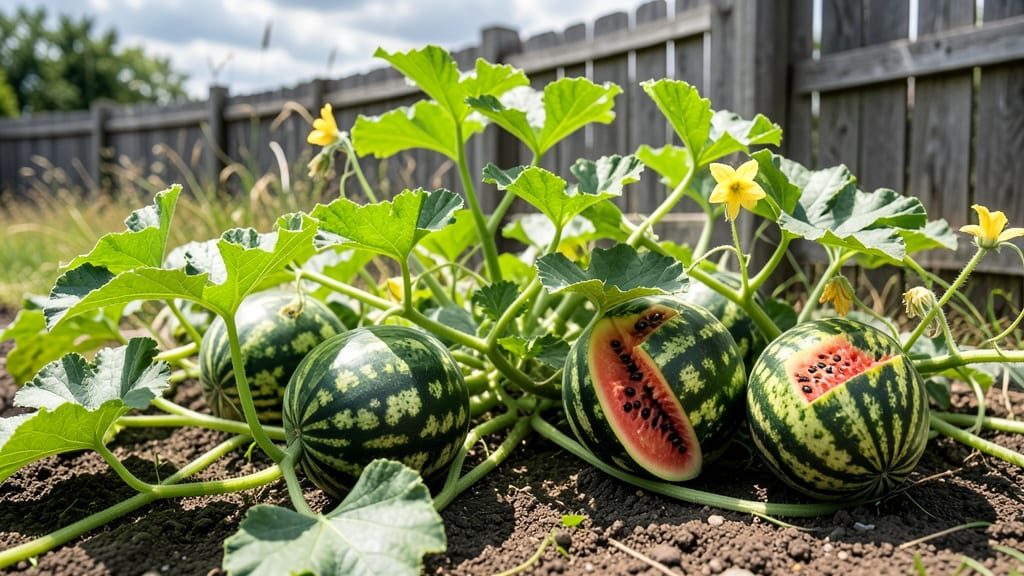
Watermelons do not self-pollinate—they require cross-pollination between male and female flowers to produce fruit. Planting multiple varieties nearby or using hand-pollination methods ensures successful fruit set and larger yields.
Watermelons rely on cross-pollination because their male and female flowers develop on separate plants—or even different branches—within the same vine. 🌱 Without bees or wind carrying pollen between flowers, the female blossoms won't develop into fruit.
This is why gardeners with single-plant gardens often see fewer melons: the flowers lack compatible pollen sources. Even in large gardens, early morning hand-pollination with a soft brush can boost fruit production when natural pollinators are scarce.
Here's the key insight: watermelon genetics play a role too.
Some varieties produce more female flowers, which need pollen to set fruit, while others focus on male flowers for pollen production. 💡 This is why planting two or more complementary varieties (like a seedless and a seeded type) often doubles your harvest potential.
The process isn't complicated—just requires understanding these natural relationships between the flowers.
💡 In This Article
- How Watermelon Pollination Works: Male vs Female Flowers
- Best Practices for Hand-Pollinating Watermelon Plants
How watermelon pollination works: male vs female flowers
Watermelon plants produce two distinct flower types that serve completely different reproductive roles. Male flowers appear first on vines, sporting a long, slender stem and no fruit-forming ovary at the base. These flowers produce pollen that must travel to female flowers to fertilize them.
The female flowers, on the other hand, have a small, round fruit at their base (the future watermelon) and a shorter stem. The key difference is that female flowers cannot produce fruit without receiving pollen from male flowers.
The pollination process relies heavily on environmental factors. Bees are the primary pollinators, drawn to watermelon flowers by their bright yellow color and sweet nectar.
A single bee can transfer pollen between 10-20 flowers in a day, but their activity peaks when temperatures are between 75-85°F with light winds. 🌿 In cooler climates or during early spring planting, you might see fewer bees, which is why hand-pollination becomes crucial.
Wind can also carry pollen, but it's far less efficient than bees—especially since watermelon pollen is relatively heavy and doesn't travel well in still air.
Here's where genetics come into play: some watermelon varieties are monoecious, meaning they produce both male and female flowers on the same plant, but not necessarily in equal numbers.
For example, seedless watermelon varieties often produce more female flowers because they've been bred for fruit development rather than pollen production.
This is why planting two complementary varieties (like one with abundant male flowers and another with abundant female flowers) can dramatically improve fruit set—up to 30-50% more yield in some cases.
The failure to pollinate properly shows up in several ways gardeners can recognize. Unpollinated female flowers will wilt and drop off within 24-48 hours without forming fruit. Even if a tiny fruit starts to develop, it may remain small (under 2 inches) and hard, a condition called "buttoning."
This happens because the ovary wasn't properly fertilized, so the fruit can't grow beyond its initial size. In extreme cases, you might see vines with abundant flowers but no fruit development at all—a clear sign of pollination failure.
What most people don't realize is that watermelon flowers have a 24-hour window for successful pollination. Once a female flower opens, it remains receptive for only about a day before its stigma (the pollen-receptive part) dries out. This is why timing matters so much in hand-pollination.
The flowers also follow a predictable pattern: male flowers typically open in the morning and remain viable for 4-6 hours, while female flowers open later in the day and close by evening. Understanding this rhythm helps gardeners intervene at the right moment.
Consider this real-world example: In a 2018 University of Georgia study, gardeners who planted three different watermelon varieties in close proximity saw a 40% increase in fruit production compared to those who planted only one variety.
The varieties complemented each other—one produced abundant male flowers early in the season, while the others had more female flowers later. This diversity in flower production created a continuous pollen supply throughout the growing season, ensuring better fruit set from start to finish. 🌱