
Vegetables
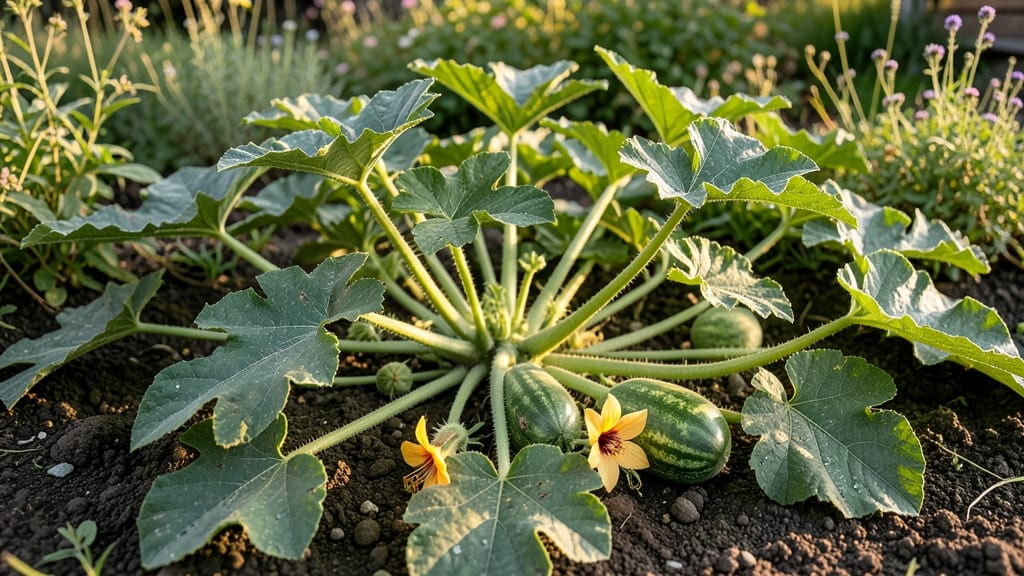
Watermelon leaves look like broad, deep green blades with 3-7 jagged lobes, rough textures, and prominent veins, growing up to 12 inches wide with a distinctive waxy sheen.
These leaves are instantly recognizable by their palmate shape—like a hand with fingers spread wide—and their serrated edges, which create a saw-tooth appearance. 🌿 The waxy coating helps repel moisture, while the veins create a network of ridges that give the leaf its characteristic 3D texture.
Unlike cucumber or squash leaves, watermelon foliage tends to be thicker and more rigid, with a slightly rougher surface that you can feel when running your fingers along the edges.
What's fascinating is how this leaf structure actually helps the plant thrive. The broad surface area maximizes sunlight absorption, while the waxy coating reduces water loss—a perfect adaptation for hot climates where watermelons originated. This combination of features makes them stand out even among other vine plants in your garden.
💡 In This Article
- Identifying Watermelon Leaves by Key Botanical Features
- How to Differentiate Watermelon Leaves from Common Garden Imposters
Identifying watermelon leaves by key botanical features
The most defining trait of watermelon leaves is their palmate shape, resembling a hand with 3-7 finger-like lobes spreading outward from a central point.
These lobes typically measure 3-6 inches long and 2-4 inches wide, creating a broad surface that can reach up to 12 inches across when fully mature. The edges aren't smooth—they feature sharp serrations that create a jagged, almost saw-tooth appearance when viewed closely.
Beneath the surface, the leaf's vein structure plays a crucial role in its identification. Watermelon leaves have a prominent central vein with secondary veins radiating outward in a web-like pattern, forming distinct ridges that give the leaf its characteristic 3D texture.
This vein network isn't just decorative—it creates a stiff, leathery structure that makes watermelon leaves feel thicker than similar-looking cucumber leaves.
The waxy coating you'll notice when running your fingers across the surface serves a vital purpose: it helps repel water and reduce moisture loss, a key adaptation for watermelons' hot, arid growing conditions.
What makes these leaves particularly distinctive is their color variation. While young leaves start as a vibrant light green, they darken to a deep, almost olive green as they mature, sometimes with a slight blue-green tint when viewed in sunlight.
This color change occurs due to increased chlorophyll production as the leaf develops. The underside often appears slightly lighter, with a subtle fuzzy texture that helps distinguish it from smoother leaves like those of cantaloupe or honeydew melons.
The leaf's arrangement on the vine also provides clues. Watermelon leaves grow alternately along the stem rather than in opposite pairs, and they often have a slightly twisted or curled appearance at the edges—a trait that sets them apart from the more uniformly flat leaves of squash plants.
This curling helps channel water away from the leaf surface during heavy rain, preventing rot. 🌱 What's fascinating is how these botanical features work together: the broad surface captures sunlight efficiently, while the waxy coating and vein structure optimize water retention and structural support.
One feature that often confuses gardeners is the leaf hairiness. While watermelon leaves are generally smooth, you may notice fine hairs along the veins or on the underside, particularly on younger leaves.
These hairs are more pronounced than those on cucumber leaves but less dense than the fuzzy coating found on some toxic look-alikes like moonflower vines. The hairs serve as a defense mechanism against pests and excessive moisture, creating a subtle texture that's worth examining closely when identifying your plants.
For those interested in the science, the palmate shape of watermelon leaves is a classic example of compound leaf structure where multiple leaflets (the lobes) radiate from a single point. This design maximizes surface area for photosynthesis while maintaining structural integrity.
The serrated edges increase the leaf's perimeter without adding bulk, allowing for more efficient gas exchange. These adaptations are why watermelon leaves stand out not just visually, but functionally in their ecosystem.