
Orchid Care
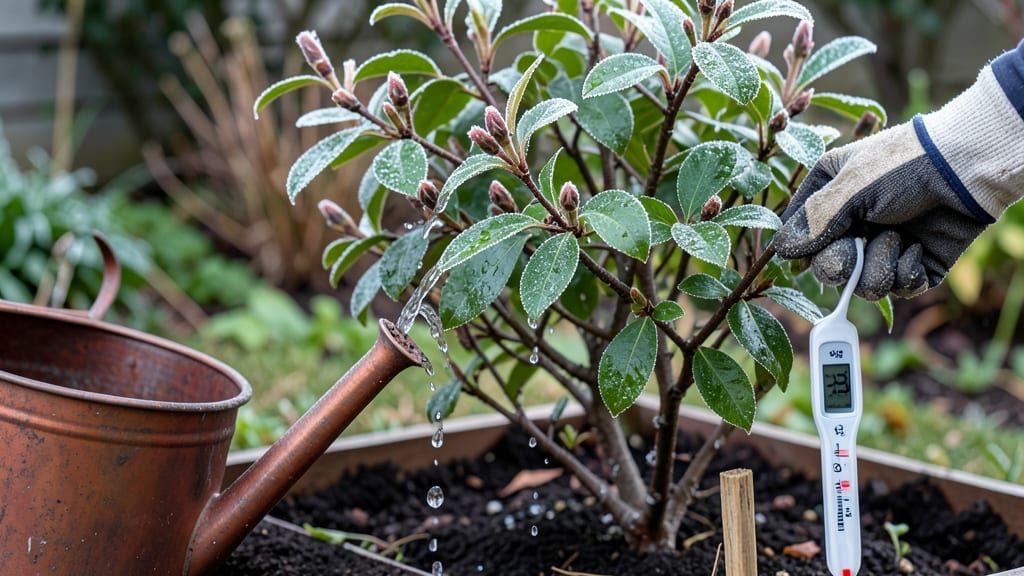
Before a freeze, you should water plants strategically to protect them, as moist soil acts as insulation for roots—but excessive watering risks ice damage. Water deeply 1-2 days before a light freeze, avoiding heavy frost events where water expands into ice.
When winter temperatures drop, soil moisture becomes a double-edged sword. 🌱 On one hand, hydrated soil retains heat better, creating a protective barrier around roots that helps prevent frost penetration.
This is especially critical for orchids and other tender plants, whose delicate systems can suffer irreversible damage from sudden cold snaps.
However, the timing and technique matter just as much as the act itself—watering too close to a hard freeze can actually worsen damage when liquid turns to ice and expands.
For most plants, I recommend deep watering 24-48 hours before a forecasted light freeze (below 32°F but above 28°F). This gives the soil time to absorb moisture while still allowing excess to evaporate.
The key is to saturate the root zone without leaving puddles—think of it like giving your plants a cozy blanket rather than a soggy one. Mulching with straw or shredded leaves after watering adds an extra layer of insulation, helping maintain stable soil temperatures throughout the night.
💡 In This Article
- How Pre-Freeze Watering Protects Plants from Cold Damage
- Best Practices for Winter Plant Watering Before Freezes
How pre-freeze watering protects plants from cold damage
The science behind pre-freeze watering lies in soil's thermal mass properties. Moist soil holds 3-4 times more heat than dry soil because water has a high specific heat capacity—meaning it absorbs and releases heat slowly.
When you water before a freeze, the soil acts like a thermal battery, gradually releasing stored warmth to buffer temperature swings. This is especially critical for orchids, whose shallow roots sit just beneath the surface where cold air penetrates most easily. 🌡️
Water also helps maintain soil structure by preventing frost heave—the destructive process where ice crystals form between soil particles and lift roots upward. When soil is moist but not saturated, the ice formation is more gradual and less damaging.
Studies show that plants in moist soil experience 20-30% less root disruption during freeze-thaw cycles compared to dry soil. The moisture also preserves beneficial soil microbes, which remain active at higher temperatures than frozen soil would allow.
Timing is everything because of water's phase change. Liquid water expands by 9% when freezing, which can rupture cell membranes in roots. That's why you should never water immediately before a hard freeze (28°F or below).
Instead, aim for 24-48 hours beforehand—enough time for excess water to drain while maintaining soil moisture. This window allows the soil to absorb water without creating ice lenses that could damage delicate root systems.
Consider the case of newly planted trees, which are particularly vulnerable. Their root balls often lack the established mycorrhizal networks of mature plants, making them more susceptible to cold stress.
A deep watering 48 hours before a 30°F night can raise soil temperatures by 2-4°F compared to dry soil, potentially making the difference between survival and damage. The moisture also helps maintain turgor pressure in roots, keeping them flexible enough to withstand minor temperature fluctuations.
For container plants like orchids, the principles are similar but the stakes are higher due to limited soil volume. Pots dry out faster and freeze more quickly. Watering 12-24 hours before a freeze ensures the root zone stays hydrated while allowing excess to evaporate from the container's surface.
The key is to avoid soggy bottoms—water until it runs through drainage holes but stop before pooling occurs. 🌱
One often-overlooked benefit is how moisture affects soil conductivity. Wet soil conducts heat 2-3 times better than dry soil, helping distribute warmth more evenly. This is particularly valuable for plants with extensive root systems like roses or fruit trees, where uniform temperature protection is crucial.
The insulation effect isn't just about keeping roots warm—it's about creating a stable microclimate that prevents the rapid temperature swings most plants can't tolerate.