
Flowers
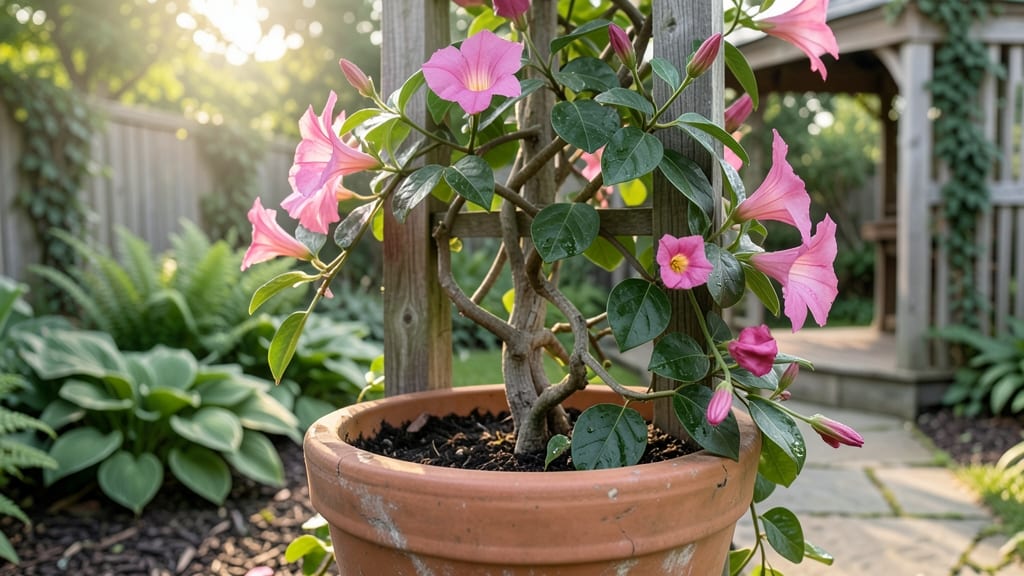
Vining mandevilla behaves as a perennial only in frost-free zones (USDA 9+), where it thrives year-round. In colder climates below 30°F (-1°C), it dies back completely, though hardy roots often survive to regrow when temperatures warm. Gardeners in colder regions must treat it as an annual or overwinter it indoors.
This tropical vine's hardiness depends entirely on your climate zone. In warm areas like Florida or Southern California, mandevilla naturally returns each spring from its deep root system, making it a reliable perennial. 🌱 However, the moment frost hits, the above-ground growth blackens and falls away—even if the roots live.
The key difference is whether your winter lows stay above 30°F (-1°C) consistently. For colder zones, overwintering requires careful pruning and protected storage, otherwise you'll need to replant each season.
What makes this tricky is that many gardeners assume "perennial" means it comes back no matter what. In reality, mandevilla's survival hinges on that 30°F threshold—just one hard freeze can kill it to the ground permanently.
The good news? Even in colder climates, with proper overwintering techniques, you can enjoy this stunning vine year after year by essentially creating your own micro-climate indoors.
💡 In This Article
- Understanding Mandevilla’s Perennial Nature by Climate Zone
- How to Overwinter Vining Mandevilla in Cold Climates
Understanding mandevilla’s perennial nature by climate Zone
The mandevilla vine's perennial status hinges on a 30°F (-1°C) temperature threshold—this is the critical line between life and death for its above-ground growth.
In frost-free zones like USDA 9-11 (think Florida, Southern California, or Hawaii), the vine naturally enters a dormant state during cooler months, with its deep, woody roots storing energy to fuel spring regrowth.
These roots can extend 3-5 feet deep in well-drained soil, where they remain protected from even brief cold snaps. 🌿 The above-ground stems may yellow and drop, but the root system stays alive, ready to burst with new growth when temperatures rise above 55°F (13°C).
In colder zones (USDA 8 and below), the story changes dramatically. When nighttime temperatures dip below 30°F (-1°C), the vine's tender stems and leaves freeze solid, turning black within 24-48 hours of exposure.
While the roots may survive brief cold snaps, prolonged freezing—especially below 20°F (-7°C)—can kill even the root system, leaving you with nothing but dead stems.
This is why mandevilla is classified as a "tender perennial" in these areas: it behaves like a perennial only when protected from frost, otherwise it acts like an annual.
The science behind this involves the vine's tropical origins. Mandevilla (Dipladenia species) evolved in Brazil, Argentina, and Peru, where temperatures rarely drop below 50°F (10°C). Its cells lack the antifreeze proteins found in cold-hardy plants like roses or hydrangeas, making it highly sensitive to frost.
Even a light frost can cause cellular damage that prevents regrowth, while roots may survive because they're insulated by soil and moisture. 🌡️ This explains why you'll see mandevilla thriving in patio pots in Zone 7 gardens during summer but dying back completely by winter—it's not a hardiness issue, it's a temperature tolerance issue.
What most gardeners don't realize is how quickly mandevilla responds to temperature changes. In spring, when soil temperatures reach 60°F (15°C), new shoots emerge from the roots within 7-10 days in ideal conditions.
This rapid regrowth is one of its most charming traits—but only works if the roots survived winter. In colder climates, this means overwintering isn't just about saving the plant; it's about preserving that critical root system that contains all the genetic information needed for next year's vine.
Consider this comparison: In Miami (Zone 10b), mandevilla grows as a true perennial with minimal care, while in Chicago (Zone 5), the same plant must be dug up, pruned, and stored indoors like a delicate houseplant. The difference isn't the plant—it's the climate.
Understanding this threshold helps explain why some gardeners in marginal zones (like Zone 8) might get partial regrowth while others get nothing: it often comes down to whether winter lows stayed above or below that 30°F (-1°C) line for more than a few hours.
For those in transition zones (like Zone 8a where winters occasionally dip below freezing), the plant's behavior becomes even more unpredictable. A mild winter might bring back a vigorous vine, while a harsh one could kill it completely.
This variability is why many gardeners in these areas choose to overwinter their mandevilla rather than risk losing it entirely. The key takeaway? Mandevilla's perennial nature is climate-dependent—it's not a one-size-fits-all characteristic but rather a delicate balance between temperature and root survival.