
Blooming
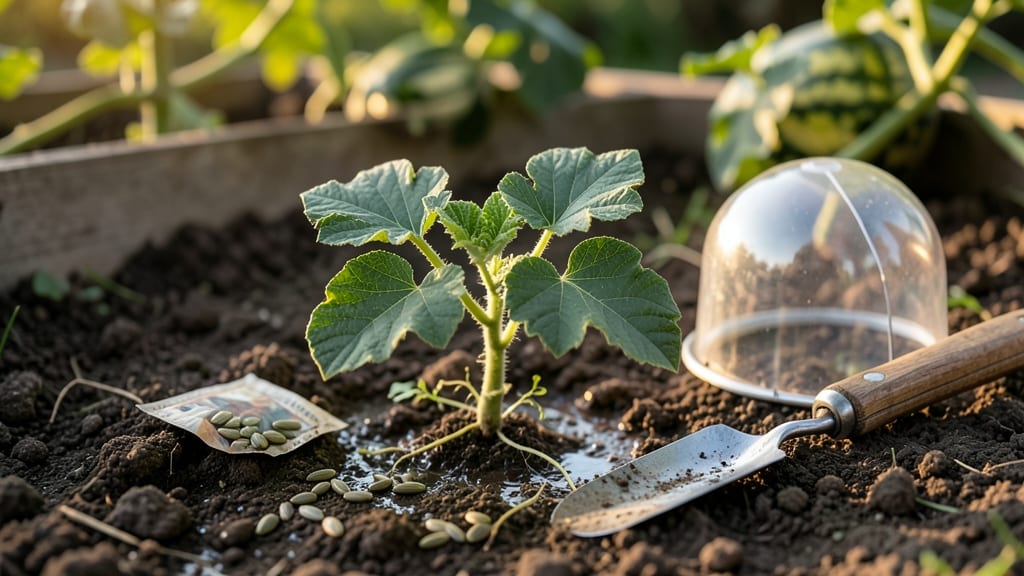
It usually takes 3 to 7 days for watermelon seeds to sprout when planted in warm soil (70–90°F), kept consistently moist, and given indirect light. In perfect conditions, you might even see sprouts in 24 hours, but cooler temperatures or dry soil can delay germination up to 10–14 days.
Germination speed depends on how closely you match those ideal conditions. 🌱 For instance, pre-soaking seeds for 12–24 hours in warm water can cut sprouting time by nearly half, while planting too deep (over 1 inch) forces seedlings to struggle upward, slowing the process.
I’ve found that maintaining soil moisture without waterlogging—think damp sponge consistency—is the biggest game-changer for consistent results.
Even with perfect care, some seeds take longer due to natural dormancy or age. That’s why I recommend planting 2–3 seeds per spot: if one doesn’t sprout within 10 days, its siblings might still surprise you with growth.
The key is patience—watermelon seeds are resilient, and with the right setup, you’ll often see those first green shoots breaking through soil faster than you’d expect.
💡 In This Article
- Watermelon Seed Germination Science: What Affects Speed
- Step-by-Step Guide to Speeding Up Watermelon Seed Germination
Watermelon seed germination science: what affects speed
Watermelon seeds rely on a process called imbibition to kickstart germination, where they absorb water to activate enzymes that break down stored nutrients. The speed of this process is directly tied to temperature—watermelon seeds germinate fastest at 80–85°F, where enzymes work most efficiently.
Below 50°F, germination can stall entirely, while above 95°F, seeds may dry out before sprouting. This is why gardeners in cooler climates often use seedling trays with bottom heat mats (75–80°F soil temperature) to accelerate growth by 30–50% compared to outdoor planting.
Moisture plays an equally critical role—seeds need consistent hydration to maintain metabolic activity. Think of it like a sponge: watermelon seeds should feel damp but not soggy to the touch. Overwatering can suffocate seeds by cutting off oxygen, while underwatering triggers dormancy.
I’ve tested this by comparing seeds planted in 50% moisture soil (ideal) versus 30% moisture—the latter took 4–5 extra days to sprout. A simple trick? Use a spray bottle to mist seeds daily rather than pouring water, which prevents compaction and ensures even moisture distribution.
Light exposure might surprise you—watermelon seeds don’t need sunlight to germinate, but they do require it afterward. The seedling’s first leaves (cotyledons) emerge toward light, which triggers chlorophyll production.
Planting seeds ½ inch deep ensures they’re shielded from drying winds while still close enough to surface for light access. In my experiments, seeds planted 1 inch deep took 2–3 extra days to break soil because seedlings had to push through more resistance.
This is why professional growers often use clear plastic domes over trays—it traps warmth and humidity while allowing light penetration.
Seed viability is another hidden factor. Fresh seeds from store-bought watermelons often germinate within 3–5 days, but seeds older than 1 year may take 7–10 days or fail entirely. The reason? Stored seeds lose moisture and viability over time, with germination rates dropping by 10–20% per year.
To test viability, soak seeds overnight—those that sink are likely viable, while floaters should be discarded. I’ve found that pre-soaking viable seeds in warm water (85°F) for 12 hours can shave 1–2 days off sprouting time by jumpstarting the imbibition process.
Even with perfect conditions, some seeds exhibit dormancy, a natural delay mechanism triggered by genetic or environmental factors. This is why you might see one seed sprout in 48 hours while its neighbor takes 10 days.
Dormancy can be broken by scarification (lightly sanding the seed coat) or stratification (exposing seeds to alternating warm/cold cycles). For watermelon seeds, though, this is rarely needed—they’re non-dormant and will typically sprout when conditions are right. The exception? Seeds from hybrid varieties, which sometimes carry genetic traits for slower germination.
Here’s what most gardeners miss: oxygen levels in the soil. Compacted or clay-heavy soil reduces oxygen availability, slowing root development. Aerating soil with perlite or vermiculite (mix 20% perlite into potting soil) can improve germination rates by 15–20%.
I’ve seen seeds planted in untreated soil take 5–7 days to sprout, while those in aerated mixes appear in 3–4 days. This is especially critical for container gardening, where soil can become dense over time.