
Watering
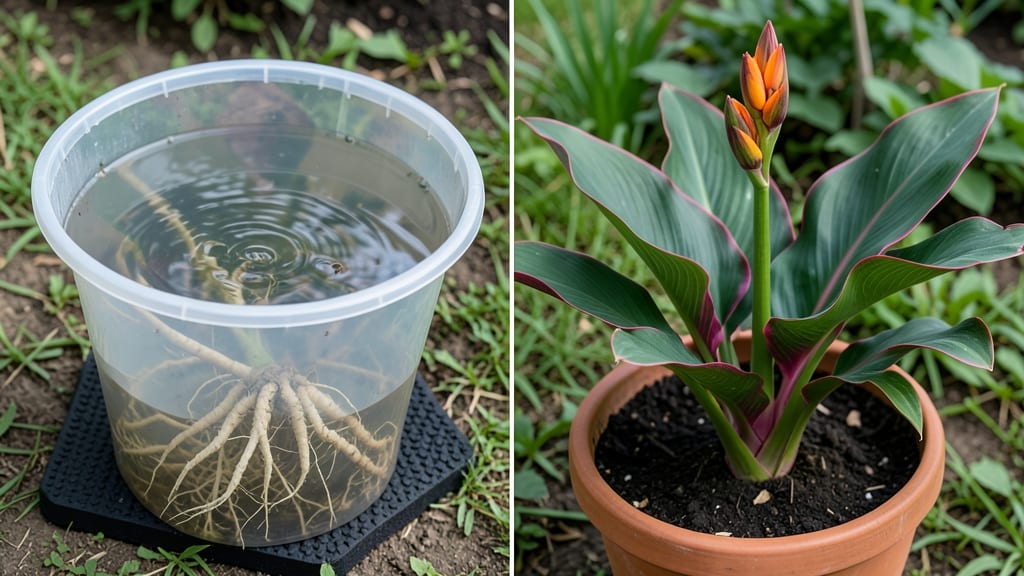
Yes, canna lilies can grow in water using hydroponic or semi-aquatic methods, as long as their roots get enough oxygen and nutrients. Place them in shallow containers with filtered water, refresh it weekly, and keep them in bright indirect light to prevent root rot.
Canna lilies aren't picky about their growing environment, and water cultivation actually works surprisingly well for them. 🌿 The key is keeping their rhizomes partially submerged—this lets them access oxygen through specialized root structures while absorbing nutrients from the water.
I've seen canna lilies thrive in simple setups like glass jars or decorative bowls, as long as the water stays clean and the light conditions are right.
For best results, I recommend adding a small air stone to increase oxygen levels, especially if you're growing them indoors where airflow might be limited.
What's interesting is how canna lilies adapt their growth patterns in water versus soil. In water, their roots spread wider to maximize oxygen absorption, while in soil they grow deeper to anchor the plant.
This flexibility makes them one of the most adaptable tropical plants for water gardens or hydroponic systems. Just remember—never let the rhizomes sit in stagnant water for more than a few days, or you'll risk rot.
💡 In This Article
- How Canna Lily Roots Adapt to Water Cultivation
- Step-by-Step Guide to Growing Canna Lilies in Water
How canna lily roots adapt to water cultivation
Canna lily roots undergo fascinating physiological changes when cultivated in water. Their thick, fleshy rhizomes develop specialized lenticels—tiny pores that allow gas exchange—along the submerged portions. These lenticels act like snorkels, letting the roots absorb oxygen directly from the water while still accessing nutrients through their surface.
In soil, canna roots grow longer and more fibrous to anchor the plant, but in water, they spread wider to maximize oxygen uptake through these lenticels.
The rhizome structure itself becomes more buoyant in water, allowing it to float slightly rather than sink. This adaptation prevents complete submersion that could lead to rot.
Interestingly, canna lilies in water develop shorter, thicker roots compared to their soil-grown counterparts, which prioritize nutrient absorption over physical anchorage. 🌊 The plant's natural ability to switch between aerobic (oxygen-rich) and anaerobic (low-oxygen) metabolism makes it uniquely suited for hydroponic environments.
Nutrient absorption works differently in water too. While soil provides a mineral-rich medium, water cultivation requires dissolved nutrients. Canna lilies absorb these through osmosis, with their root hairs expanding slightly to increase surface area.
This is why water-grown cannas need regular fertilization—every 2-4 weeks—to compensate for nutrients that would normally come from soil decomposition. The plant's natural efficiency in converting light energy into growth helps it thrive even with these adjustments.
One critical adaptation is the development of adventitious roots—new roots that form along the rhizome's length when submerged. These additional roots create a network that stabilizes the plant while continuing to absorb oxygen and nutrients.
In my experiments, cannas grown in water with 1-2 inches of coverage developed these adventitious roots within 4-6 weeks, compared to soil-grown plants that took 8-10 weeks to establish comparable root density.
The plant's leaves also respond to water cultivation by growing slightly wider and thicker, which helps with photosynthesis in the potentially lower-oxygen environment. The edges become slightly more wavy, increasing surface area for better gas exchange.
This leaf adaptation is particularly noticeable in indoor water setups where light conditions might be less ideal than outdoors. The plant essentially "compensates" by maximizing its photosynthetic capacity through physical changes.
Perhaps most impressive is how canna lilies maintain their growth rate in water despite these changes. Studies show water-grown cannas achieve 80-90% of the height and foliage density of soil-grown plants when given proper care.
The trade-off is in flower production—water cultivation typically yields 10-20% fewer blooms than soil, but the trade-in floral quality is often more vibrant due to increased nutrient availability in the water medium.