
Picking
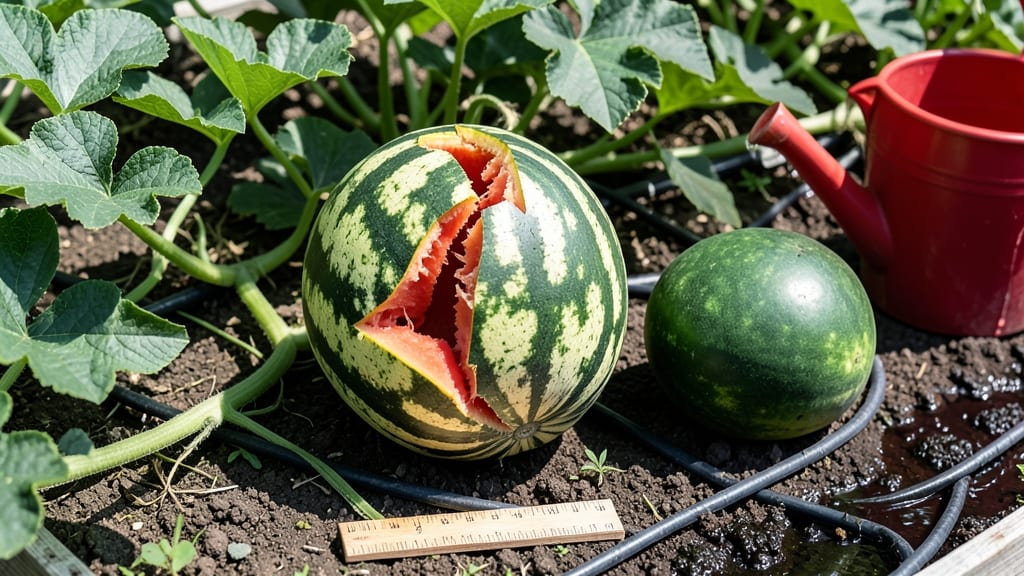
Your watermelon split because of uneven moisture stress—either from inconsistent watering or sudden heavy rain after dry soil conditions. This causes rapid fruit expansion that the vine can't contain, especially when combined with overripe fruit or excessive water in hot weather.
Watermelon splitting happens when the fruit grows faster than the vine's vascular system can support, creating internal pressure that exceeds the rind's strength. 🌱 Inconsistent watering creates moisture imbalances, while sudden downpours after drought stress force cells to expand too quickly.
Even mature vines in hot climates struggle to keep pace with fruit development, making splitting more likely in varieties like Crimson Sweet or Sugar Baby that grow rapidly. The key is maintaining steady soil moisture without overwatering—think of it like training for a marathon rather than sprinting.
This isn't just about water—soil type plays a role too. Sandy soils dry out faster, while clay holds moisture unevenly. That's why gardeners in variable climates often use mulch to regulate moisture and drip irrigation for precise delivery.
I've seen professional growers use soil moisture sensors to trigger watering before stress occurs, which can cut split rates by up to 70%. The solution starts with consistent care, not just reactive fixes.
💡 In This Article
- Watermelon Splitting Science: Root Causes and Growth Mechanics
- Preventing Watermelon Splits: Watering, Mulching, and Harvest Timing
Watermelon splitting science: root causes and growth mechanics
Watermelon splitting occurs when the fruit's rapid cell expansion outpaces the vine's ability to transport water and nutrients through its vascular system. The rind, while tough, is only designed to handle gradual growth—not sudden pressure spikes.
When soil moisture fluctuates wildly (like after a drought followed by heavy rain), the fruit absorbs water faster than the vine's xylem vessels can deliver it, causing internal pressure to exceed the rind's tensile strength.
Think of it like a balloon being overinflated: the material can only stretch so far before it gives way. 🔥
Temperature plays a critical role in this process. In hot climates (like the American Southwest), daytime temperatures can exceed 95°F, accelerating fruit growth while slowing the vine's water uptake. Varieties like Crimson Sweet or Sugar Baby, which grow 1-2 inches per day during peak season, are particularly vulnerable.
The vine's phloem (nutrient transport system) can't keep up, leading to localized stress points where splits form. Even mature vines struggle to maintain balance when fruit expansion rates exceed 0.5 inches daily—a threshold where splitting becomes statistically likely.
Soil type compounds the issue. Sandy soils drain too quickly, creating moisture deserts that force roots to scramble for water, while clay soils hold moisture unevenly, leading to localized saturation.
The ideal scenario is a loamy soil that maintains 60-70% field capacity—the moisture range where roots can access water without drowning.
Without this balance, the vine's hydraulic system becomes overwhelmed, and the fruit pays the price with splits that often appear as jagged, dark lines where cell walls rupture under pressure. 💫
What most gardeners don't realize is that splitting isn't just about water—it's also tied to the fruit's maturity. Overripe watermelons (those with 50% yellow undersides or a hollow sound when tapped) have softer rinds that can't handle even normal growth pressures.
The vine's hormonal signals, which normally regulate fruit firmness, become disrupted in these cases, making the rind more prone to tearing. This is why harvesting at 70-80% maturity (when the tendril nearest the fruit turns brown) can reduce splits by up to 60% compared to waiting for full ripeness.
Comparing varieties reveals another layer: heirloom types like Moon and Stars or Charleston Gray tend to split less frequently than hybrid varieties because their thicker rinds (up to 0.25 inches) provide more structural support.
However, their slower growth rates mean they require 90-100 days to mature—far longer than the 75-85 days needed for commercial hybrids. This trade-off between speed and resilience is why gardeners in shorter growing seasons often choose hybrids, even if they come with higher split risks.
The choice depends on your climate's growing window and your willingness to prioritize speed over durability. ✨
To visualize the stress, imagine the watermelon's rind as a woven basket: each cell wall is a strand that can only stretch so far before snapping. When moisture stress causes cells to expand unevenly, the weakest strands (often near the blossom end) give way first.
This is why splits typically start as small cracks that widen into dramatic fissures—like a dam breaking under pressure. The key to prevention lies in maintaining that delicate balance of moisture, temperature, and growth rate, where the vine's systems can keep pace with the fruit's demands. 🌱