
Companion Plants
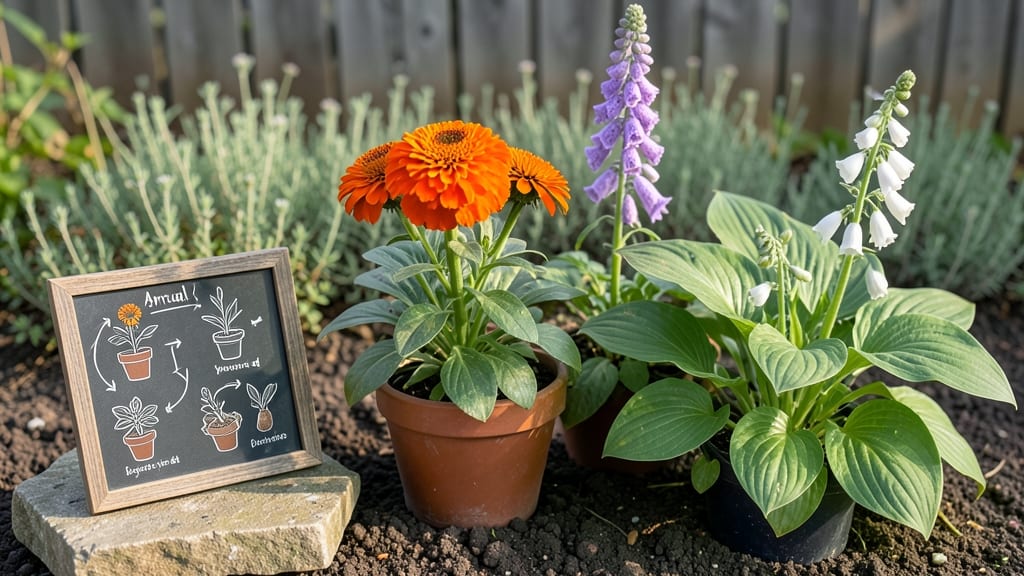
The difference between annual, biennial, and perennial plants lies in their growth cycles: annuals live just one season, biennials take two years to flower and set seed, and perennials return year after year from the same root system. This affects everything from planting timing to garden design and maintenance.
The key distinction isn't just how long they live, but how they allocate energy.
Annuals like marigolds focus all their resources on rapid growth and reproduction within a single season. 🌱 Biennials, such as carrots or foxgloves, invest their first year building strong roots and leaves, then flower and produce seeds in their second year.
Perennials like lavender or hostas, however, develop deep root systems that store energy, allowing them to push new growth above ground each spring without starting from seed every time.
This biological difference directly impacts your gardening approach. Annuals give you quick color or harvests but require replanting yearly, while perennials offer long-term beauty with less upkeep. Biennials act as a bridge, often providing edible roots or foliage in year one and flowers in year two.
Understanding these cycles helps you plan for seasonal succession planting, overwintering strategies, and creating layered garden beds that bloom continuously.
💡 In This Article
- Lifespan and Growth Cycle Mechanics of Annuals, Biennials, and Perennials
- Practical Gardening Strategies for Annual, Biennial, and Perennial Plant Selection
Lifespan and growth cycle mechanics of annuals, biennials, and perennials
At the core of these plant types lies their biological programming—how they allocate energy and respond to environmental cues. Annuals like zinnias or sunflowers follow a fast-track lifecycle triggered by day length (photoperiod) and temperature.
Once seeds germinate, they prioritize rapid growth to reach maturity before the first frost, typically within 60-120 days. Their stems remain non-woody and often succulent, storing minimal reserves, which explains why they die when temperatures drop below 32°F.
This survival strategy relies entirely on producing seeds before the season ends.
Biennials like parsley or hollyhocks employ a two-phase energy strategy. In their first year, they focus on building storage organs—roots (e.g., carrots), bulbs (e.g., onions), or taproots (e.g., beets)—that can survive winter. These structures accumulate starches and sugars, sometimes reaching 10-15% dry matter content by dormancy.
The second year, when exposed to longer daylight hours and warmer temperatures, they trigger flowering hormones (florigen) that convert stored energy into flower and seed production. This explains why biennials often bolt (suddenly flower) when day lengths exceed 14-16 hours.
Perennials like peonies or asclepias (butterfly weed) operate on a sustainable energy model with meristematic tissues—undifferentiated cells in roots, crowns, or rhizomes—that can regenerate above-ground growth annually. Their root systems may extend 3-6 feet deep, accessing water and nutrients year-round.
Perennials also produce bud scales that protect meristems during winter, allowing them to "remember" their growth pattern. This is why perennials often bloom at the same time each year—it's a genetically programmed response to consistent environmental triggers like chilling hours (300-1,500 hours below 45°F).
Here's where it gets fascinating: photoperiodism (light sensitivity) and vernalization (cold requirement) act as master switches. Short-day plants (e.g., chrysanthemums) need less than 12 hours of light to flower, while long-day plants (e.g., spinach) require 14+ hours.
Biennials often need both vernalization (e.g., 4-8 weeks at 35-50°F) and proper daylight to trigger flowering. Annuals, however, are typically day-neutral—they flower based on plant age rather than light exposure, which is why you can grow them year-round in greenhouses.
Consider the sensory differences in these cycles: Annuals like basil release their signature aroma when crushed because they've evolved to attract pollinators quickly in a single season. Biennials often have stronger root flavors in year one (think radishes) that mellow in year two.
Perennials develop complex, layered scents over time—lavender's citrusy notes deepen as the plant ages, while peonies' fragrance intensifies with each returning bloom cycle. 🌿
Understanding these mechanisms helps explain why some plants thrive in your climate while others struggle. For example, biennials like parsley often flower prematurely in warm-winter regions because they don't get sufficient chilling hours.
Perennials may fail to establish if planted too late in the season, as their root systems need 6-8 weeks of growth before winter to store enough energy for next year's growth.