
Companion Plants
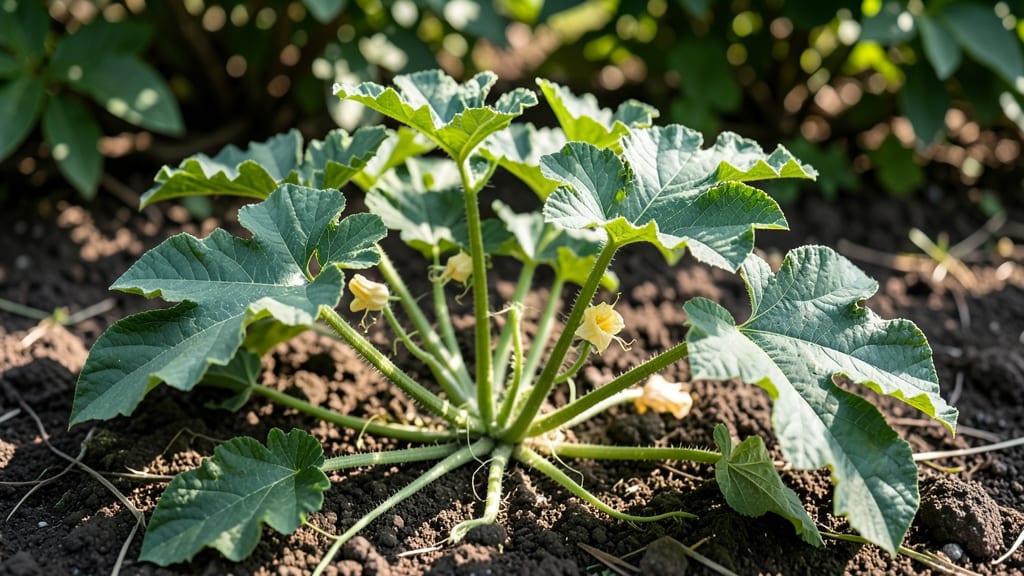
Young watermelon plants look like tender vines with fuzzy, round leaves that have scalloped edges and prominent veins, sprouting their first true leaves just above the soil line. These seedlings grow quickly upward before sprawling horizontally, making early identification crucial to avoid mistaking them for weeds or other garden vines.
Those distinctive fuzzy leaves are your first clue—watermelon seedlings develop a soft, hairy texture that helps them conserve moisture in warm climates. 🌱 Unlike cucumber or squash plants, which often have broader leaves, watermelon leaves start small and lobed, resembling tiny maple leaves.
I always check for these tendrils when differentiating them from weeds, as they begin curling within weeks of sprouting.
Here's why timing matters: the first true leaves (not the initial cotyledons) appear about 7-10 days after planting, signaling it's time to thin seedlings if they're crowded. Healthy stems should be firm and slightly waxy, while yellowing or wilting indicates overwatering or poor drainage.
Pro tip: use a magnifying glass to spot the serrated edges—they're subtle but unmistakable once you know what to look for.
💡 In This Article
- Identifying Watermelon Seedlings by Leaf Shape and Growth Patterns
- Watermelon Plant Growth Stages: From Sprout to Vining
Identifying watermelon seedlings by leaf shape and growth patterns
The first clue to spotting young watermelon seedlings lies in their cotyledons—the initial leaves that emerge from the seed. Unlike true leaves, cotyledons are smooth, round, and typically 1-2 inches wide with a pale green hue.
These baby leaves lack the fuzzy texture and lobes that define watermelon's mature foliage, but they serve as a temporary energy source while the plant establishes roots. 🌱 What sets them apart from weeds is their rapid growth: within 3-5 days, these cotyledons unfurl into the first true leaves, which are where the real identification magic happens.
True watermelon leaves begin as 3-5 lobed structures with serrated edges, resembling miniature maple leaves but with a velvety, downy texture. Under magnification, you'll notice prominent veins radiating from the center, creating a web-like pattern that's more intricate than cucumber leaves.
The fuzzy coating isn't just for show—it's a survival adaptation that reduces water loss in hot climates. Compare this to squash seedlings, which develop broader, more rounded leaves with smoother edges and fewer lobes, or cucumber vines that produce heart-shaped leaves with jagged teeth.
Growth speed is another key differentiator. Watermelon seedlings shoot upward at a 1-2 inch per day rate during their first two weeks, reaching 4-6 inches tall before they begin their characteristic horizontal sprawl.
This vertical growth phase is when tendrils start forming—thin, curly structures that help the vine anchor itself to nearby plants or supports. 🌿 These tendrils appear 2-3 weeks after germination and are your final confirmation that you're dealing with watermelon rather than a squash or pumpkin, which develop broader, more rigid stems without tendrils until much later.
The color gradient of healthy watermelon leaves provides additional clues. New growth emerges with a deep green hue on the upper surface, while the undersides maintain that signature fuzzy texture with a slightly lighter green tint.
Yellowing between veins (a condition called chlorosis) signals nutrient deficiencies, often iron or magnesium, while brown spots indicate fungal issues like powdery mildew.
Pay special attention to the leaf margins—true watermelon leaves develop shallow serrations about 1/4 inch apart, creating a scalloped appearance that's more pronounced than on cucumber leaves.
For visual confirmation, hold a seedling up to natural light and look for these distinguishing features:
- Leaf shape: 3-5 rounded lobes with serrated edges (like a tiny maple leaf)
- Texture: Velvety or fuzzy coating on both sides (use your fingers to feel the difference)
- Veins: Prominent, web-like pattern radiating from center
- Growth habit: Rapid vertical growth followed by horizontal vining
- Tendrils: Appear within 2-3 weeks as curly structures
What most gardeners overlook is how watermelon seedlings develop alternate leaf arrangement—each new leaf grows from a different node along the stem, creating a staggered pattern.
This contrasts with many weeds that have opposite or whorled leaf arrangements. 🌱 By combining these visual markers with growth habits, you can confidently distinguish watermelon seedlings from common imposters like morning glory vines or even young pumpkin plants, which often get mistaken for watermelon in early stages.