
Flowers
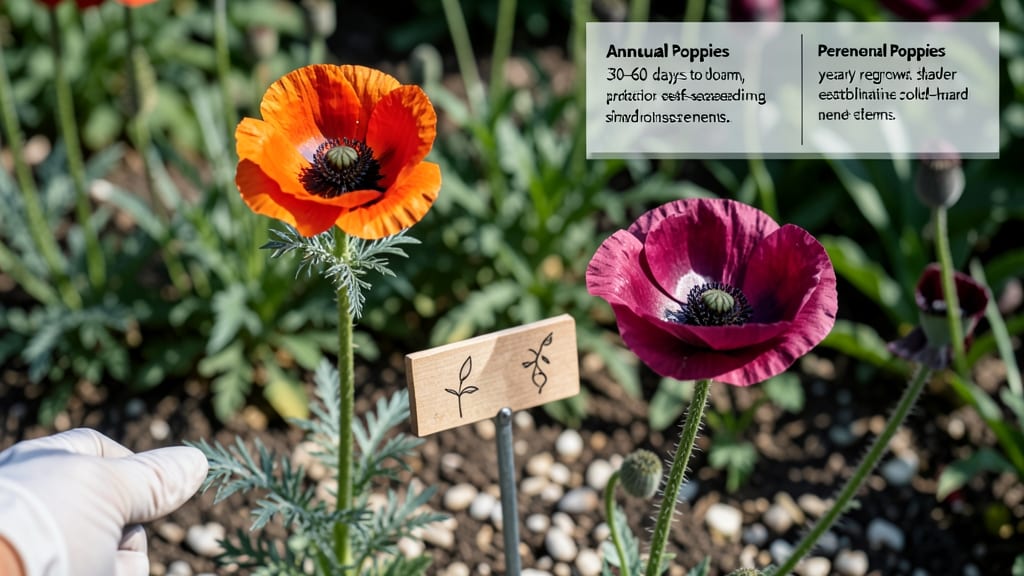
Poppy flowers are annuals, meaning they complete their life cycle in one growing season, though some varieties self-seed prolifically to create the illusion of perennial behavior through natural regeneration. Their underground taproots store energy for regrowth if conditions allow, but the plants themselves do not persist as true perennials.
This distinction matters because poppies rely on their self-seeding ability rather than persistent roots to return year after year. 🌱 Once mature, they release thousands of seeds that lie dormant until spring's warmth triggers germination, creating new plants.
The taproot system stores nutrients but doesn't regenerate the entire plant—think of it as nature's backup system rather than true perennial survival. Many gardeners mistakenly assume poppies are perennials because they seem to "come back," but this is actually a clever survival strategy rather than biological persistence.
The key difference lies in their reproductive strategy: true perennials regrow from the same root system annually, while poppies rely on seed dispersal. This means their "return" each year is actually new plants growing from seeds dropped the previous season, not the same plant surviving.
Understanding this helps explain why some poppy varieties appear more reliable than others—those with more aggressive self-seeding habits will naturally appear more "perennial" in behavior.
💡 In This Article
- Why Poppies Die Back Every Year (Life Cycle Science)
- How to Encourage Poppy Regrowth Year After Year
Why poppies die back every year (life cycle science)
Poppies follow a strict annual life cycle because they're genetically programmed to complete their entire growth, flowering, and seed production within one growing season. The process begins when seeds germinate in spring, triggered by soil temperatures reaching 50-60°F—a threshold that signals safe conditions for growth.
This temperature sensitivity ensures poppies only emerge when daytime warmth and moisture align, typically between March and May in temperate climates. 🌱
The plant's energy storage system relies on a deep taproot that can extend 2-3 feet underground, storing carbohydrates and nutrients. Unlike perennials that develop woody stems or rhizomes for year-round survival, poppy taproots serve as temporary energy reserves.
When temperatures drop below 40°F in autumn, the above-ground foliage dies back completely, but the taproot remains dormant until spring. This dieback isn't a sign of failure—it's an essential survival adaptation that prevents energy waste during winter.
What creates the "perennial illusion" is the plant's self-seeding strategy. A single mature poppy can produce 2,000-3,000 seeds that scatter widely, often remaining viable in the soil for 2-3 years. These seeds lie dormant until environmental cues (like consistent moisture and warmth) trigger germination.
This means you might see poppies appearing in the same spot year after year, but they're actually new plants from seeds dropped by previous generations—not the same plant returning.
The confusion arises because some poppy varieties, like the California poppy (Eschscholzia californica), have evolved to thrive in dry climates where annual growth is safer than investing in perennial structures. Their seeds contain natural dormancy-breaking chemicals that only activate when conditions are ideal, creating the appearance of reliability.
In contrast, true perennials like peonies or hostas develop specialized underground structures (tubers, rhizomes) that regenerate the same plant year after year.
Temperature plays the most critical role in this cycle. Poppies cannot survive freezing temperatures in their above-ground state, which is why they die back completely each winter. The taproot's survival mechanism is purely a temporary energy store—not a regenerative system like perennial roots.
This explains why poppies often appear more vigorous in USDA zones 7-10, where winters are mild enough to allow some seed survival without complete die-off.
Here's what's actually happening underground: The taproot depletes its stored energy during the growing season, then enters a state of seasonal dormancy rather than true hibernation. While it may remain viable for a few years, it lacks the specialized cells that perennials use to regenerate shoots.
This is why gardeners often see poppies "disappear" after a few years—the seeds either germinate successfully or lose viability over time, especially in disturbed soils.