
Vegetables
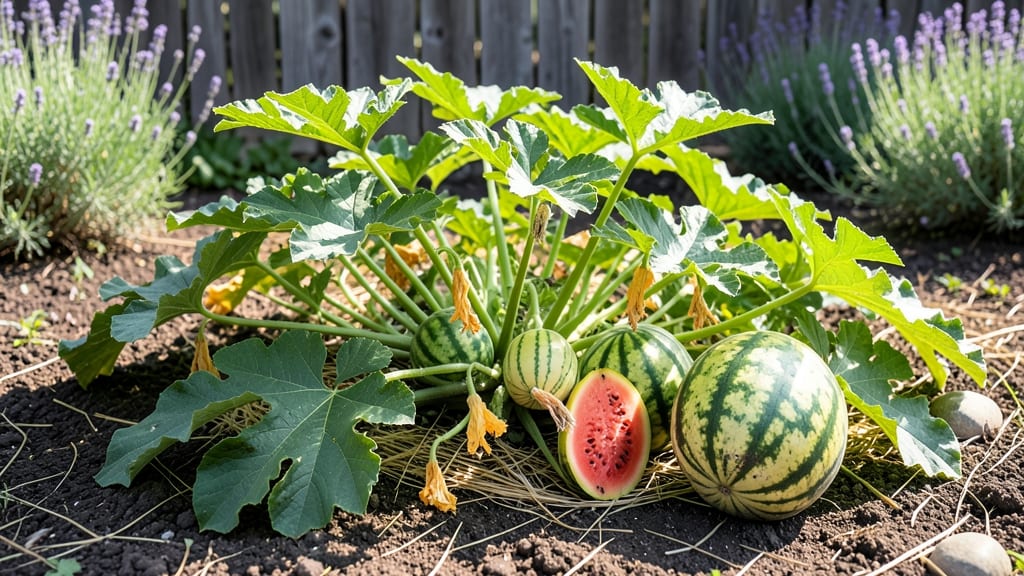
Seedless watermelons are grown by cross-pollinating regular watermelon plants with special tetraploid varieties, creating triploid seeds that produce fruit without viable seeds. This advanced breeding method maintains the melons' signature sweetness and juiciness while eliminating the need for seed removal.
This clever genetic trick relies on chromosome doubling, where watermelon plants with four sets of chromosomes (tetraploid) are used to pollinate normal two-chromosome (diploid) plants. 🌱 The resulting triploid seeds grow into fruit that's completely seedless because the chromosomes can't properly pair during reproduction.
While this method requires careful pollination control, it's what gives seedless watermelons their consistent texture and flavor that gardeners and grocery shoppers love.
What makes this process special is that the resulting fruit doesn't just lack seeds—it often develops a more concentrated sweetness since all the plant's energy goes into flesh development rather than seed production.
Farmers need to source these specialized seeds from agricultural suppliers who maintain the precise genetic ratios, making home gardening with seedless varieties more challenging than with traditional watermelons.
💡 In This Article
- The Science Behind Triploid Seedless Watermelon Pollination
- Growing Seedless Watermelons: Step-by-Step Gardening Guide
The science behind triploid seedless watermelon pollination
Seedless watermelons owe their existence to a fascinating genetic trick involving chromosome counts. Normal watermelon plants are diploid, meaning they have two sets of chromosomes (2n). But to create seedless fruit, breeders use tetraploid plants—those with four sets of chromosomes (4n)—as pollen donors.
When pollen from a tetraploid plant fertilizes a normal diploid watermelon flower, the resulting seed contains three sets of chromosomes (3n), making it triploid.
Here's where the magic happens: triploid plants produce fruit that's sterile because their chromosomes can't properly pair during meiosis (the cell division process that creates seeds). Without viable seeds, the watermelon's energy goes entirely into developing sweet, juicy flesh.
The best seedless varieties maintain 12-14% sugar content—similar to premium seeded watermelons—while offering the convenience of no pit removal. 🌱 This process was first perfected in the 1970s by Japanese and American agricultural researchers who identified specific watermelon varieties that could reliably produce triploid seeds.
The key to maintaining seedlessness lies in precise pollination control. Farmers must use tetraploid watermelon plants as pollen sources while ensuring they don't self-pollinate with other tetraploid plants (which would produce viable seeds). This requires either physical separation of plant varieties or careful hand-pollination techniques.
The resulting triploid seeds are then planted to grow the familiar seedless watermelons we find in stores. Interestingly, these triploid plants themselves are sterile and won't produce seeds if allowed to flower naturally.
What makes this technique particularly clever is how it leverages natural plant biology. The triploid condition creates what's called "gynogenesis"—a process where the female parent's genetic material dominates while the male contribution gets "diluted" by the extra chromosome set.
This results in fruit that's genetically uniform and consistently seedless across the entire harvest. The trade-off? These specialized seeds are more expensive and harder to find than regular watermelon seeds, which is why seedless varieties typically cost more at market.
Breeders have also discovered that certain watermelon varieties respond better to this triploid process. For example, the popular 'Sugar Baby' seedless variety maintains excellent texture and sweetness because it was developed from parents with naturally high sugar content.
The chromosome doubling technique doesn't just remove seeds—it often enhances the fruit's quality by concentrating flavor compounds in the flesh. This is why seedless watermelons frequently win taste tests against their seeded counterparts.
One fascinating side effect of this genetic process is that seedless watermelons tend to have slightly larger cells in their flesh, giving them a more uniform texture. The lack of seeds also means the fruit can develop a thicker rind relative to its size, making them more durable during transport.
However, this comes with a trade-off: seedless varieties often require more precise growing conditions to achieve optimal flavor, as they're more sensitive to temperature fluctuations during development.