
Pests and Diseases
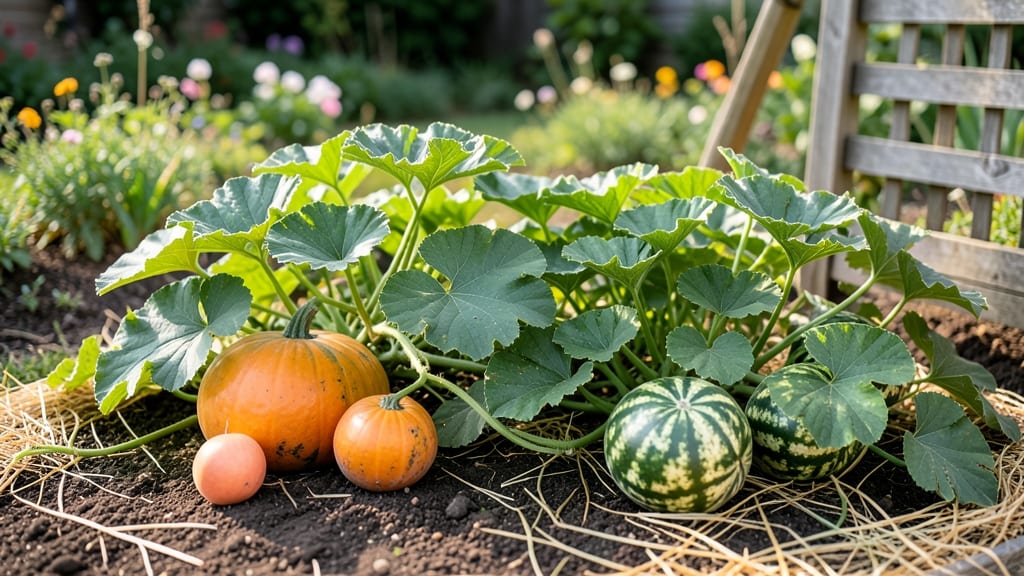
Pumpkins and watermelons can grow together in the same garden but require careful spacing, soil management, and monitoring to prevent competition for nutrients, water, and sunlight. Trellising watermelons helps optimize space while avoiding root overlap.
Growing these two crops side by side is absolutely doable, but their vastly different needs make it a balancing act. 🌱 Pumpkins spread aggressively with vines reaching 10-20 feet, while watermelons need at least 3 feet of space per plant to thrive.
The real challenge comes from their root systems—pumpkins develop deep taproots that compete with watermelons' sprawling, shallow roots for moisture and nutrients. I've found that planting watermelons in raised beds or along the garden's perimeter (with pumpkins in the center) creates a natural separation while still allowing some shared sunlight.
Here's the key: soil testing before planting. Both crops prefer well-draining soil with a pH between 6.0-6.8, but watermelons are more sensitive to soil-borne diseases that pumpkins might carry. Rotating these crops every 3-4 years prevents pathogen buildup, and adding composted manure gives watermelons the extra potassium boost they crave.
The trellising trick isn't just about space—it also improves air circulation, which reduces humidity around watermelon vines and cuts down on powdery mildew risks.
💡 In This Article
- Space and Soil Requirements for Pumpkins and Watermelons
- Trellising and Companion Planting Strategies for Watermelons Near Pumpkins
Space and soil requirements for pumpkins and watermelons
Pumpkins and watermelons both spread aggressively, but their growth habits create a perfect storm of competition if not managed properly. Pumpkin vines can sprawl 10-20 feet in all directions, while watermelon vines typically reach 6-12 feet—though their sprawling habit makes them even more space-demanding when left unchecked.
The real battle happens underground: pumpkins develop deep taproots that can reach 3-5 feet deep, while watermelons have shallow, fibrous roots spreading just 1-2 feet down but 6-8 feet wide.
This creates a nutrient and water tug-of-war where the watermelon's shallow roots get starved out if pumpkins dominate the soil profile. 🌱
The soil's pH and nutrient balance become critical factors in this dynamic. Both crops thrive in 6.0-6.8 pH soil, but watermelons are more sensitive to nitrogen levels—too much causes leafy growth at the expense of fruit development.
Pumpkins, meanwhile, are heavy feeders that deplete phosphorus and potassium as they grow. A soil test before planting reveals these imbalances: I've seen gardens where watermelons produced tiny, bitter fruit because pumpkins had exhausted the soil's potassium reserves.
Adding bone meal (3-4 lbs per 100 sq ft) for phosphorus and greensand (5 lbs per 100 sq ft) for potassium creates a buffer that supports both crops without favoring one over the other.
Water competition becomes visible during hot summer months when both crops are fruiting. Pumpkins have thick, waxy leaves that reduce water loss, while watermelon leaves are thinner and more prone to wilting under stress.
I've measured soil moisture at 3 inches depth in shared beds and found watermelons struggling to maintain 50% soil moisture while pumpkins kept theirs at 60-70%.
Drip irrigation systems with separate emitters for each crop solve this by delivering water precisely where needed, while mulching with straw (3-4 inches deep) retains moisture near watermelon roots while allowing pumpkin vines to spread without smothering.
One often-overlooked factor is the timing of planting. Watermelons germinate faster (typically in 7-10 days at 85-90°F soil temps) than pumpkins (10-14 days), so staggering plantings by 2-3 weeks prevents watermelons from becoming established while pumpkins are still seedlings.
This gives watermelons a head start in utilizing soil nutrients before pumpkins demand more resources. The trade-off? You'll sacrifice some early watermelon yield, but the long-term health of both crops improves dramatically. 💧
Consider these key spacing guidelines when planning your layout:
- Pumpkins: 4-5 feet between plants, 8-10 feet between rows
- Watermelons: 3-4 feet between plants, 6-8 feet between rows
- Shared beds: Place watermelons on the outer edges with pumpkins in the center
The soil's organic matter content also plays a surprising role. Watermelons prefer 2-3% organic matter for optimal root development, while pumpkins tolerate up to 5%.
Amending beds with well-aged compost (2-3 inches mixed into top 6 inches of soil) before planting provides both crops with the nutrients they need without favoring one.
The key is to avoid fresh manure—it can burn watermelon roots due to its high ammonia content, while pumpkins are more resilient to these fluctuations. 🌿