
Tools
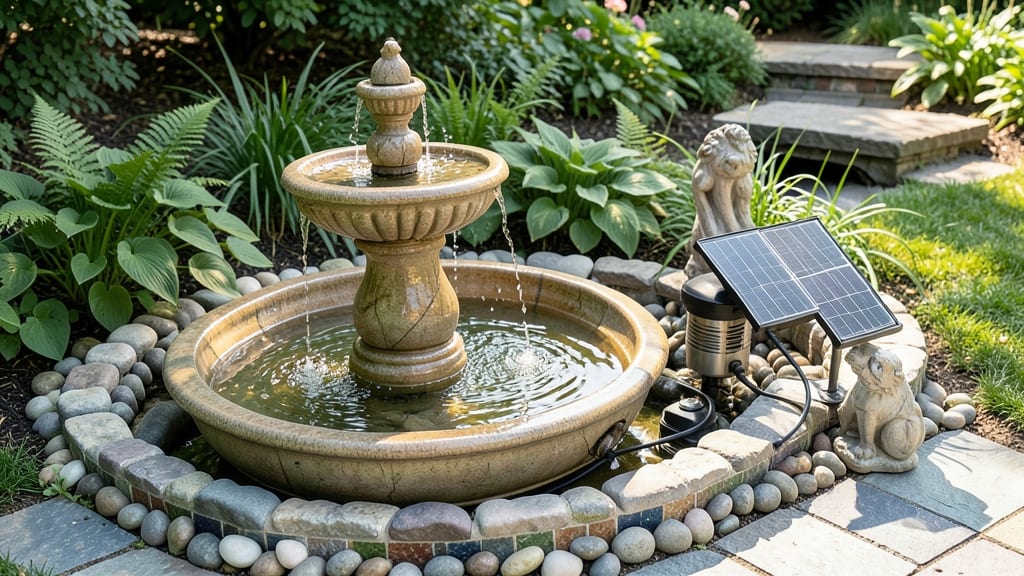
Garden fountain water usage depends on size: small tabletop models need 1 to 5 gallons per hour, mid-sized tiered fountains require 5 to 15 gallons per hour, and large basin fountains use 15+ gallons per hour, based on pump flow rates and basin capacity. Always verify manufacturer specifications for exact water volume needs.
Your fountain's water needs aren't just about size—they're tied to how the pump circulates water. A recirculating system (where water flows continuously) uses far less than a fountain that drains and refills daily.
For example, a 5-gallon-per-hour pump in a 10-gallon basin might only need a 1-gallon top-off every 2 hours in hot climates due to evaporation. 💫 The key is balancing pump power with basin volume to minimize waste while keeping water fresh.
Pro tip: Solar-powered pumps can cut costs and water use by up to 30% compared to electric models. Many manufacturers now include low-flow settings—perfect for conserving water without sacrificing that soothing sound.
Always check your pump's GPH (gallons per hour) rating and divide it by your basin's size to estimate refill frequency.
💡 In This Article
- How Fountain Pump Flow Rates Determine Water Usage
- Best Water Management Tips for Garden Fountains
How fountain pump flow rates determine water usage
The heart of your fountain's water efficiency lies in its pump's gallons per hour (GPH) rating, which measures how much water the pump moves through the system per hour.
For instance, a small 3-gallon-per-hour pump in a 5-gallon basin will circulate water completely every 1.67 hours (5 ÷ 3 = 1.67). This continuous movement creates the visual effect of a flowing fountain while using minimal fresh water—just enough to replace what evaporates or splashes out.
Basin size plays a critical role in water displacement. A 10-gallon tiered fountain with a 5-GPH pump will have water turnover every 2 hours, but if the basin is only 3 gallons (like some tabletop models), the same pump would cycle water every 36 minutes.
The larger the basin relative to the pump's flow rate, the longer water stays in circulation before needing a top-off, reducing overall water waste. 💫 This is why recirculating systems (where water stays in the fountain) are far more efficient than designs that drain and refill daily.
Here's the science: The pump's head pressure (measured in feet) determines how high it can push water, while GPH measures volume. A 10-foot head pressure pump with 5 GPH might struggle to fill a multi-tiered fountain with narrow spouts, as the water flow becomes restricted.
Always match your pump's specs to your fountain's design—undersized pumps create weak flow, while oversized ones waste energy and water.
Evaporation rates add another layer. In 90°F (32°C) heat, a fountain can lose 0.5 gallons per day through evaporation, while in 50°F (10°C) weather, loss drops to 0.1 gallons daily.
Multiply your daily evaporation rate by your fountain's surface area (larger basins evaporate faster) to estimate how often you'll need to refill. For example, a 20-gallon basin in summer might need 1 gallon added every 2 days—not the 20 gallons many assume!
Pro tip: Use this simple formula to estimate refill needs: Refill Frequency (hours) = Basin Size (gallons) ÷ (GPH ÷ 24) For a 15-gallon fountain with a 3-GPH pump: 15 ÷ (3 ÷ 24) = 120 hours (or 5 days) between top-offs in ideal conditions.
Adjust for climate and splash factors!
What most people overlook is how water feature design affects efficiency. Fountains with wide, shallow basins evaporate faster than deep, narrow ones because surface area exposure increases.
Adding submersible pumps (which draw water from the bottom) also reduces splashing, cutting evaporation by up to 40% compared to surface pumps that create more aeration.