
Plants
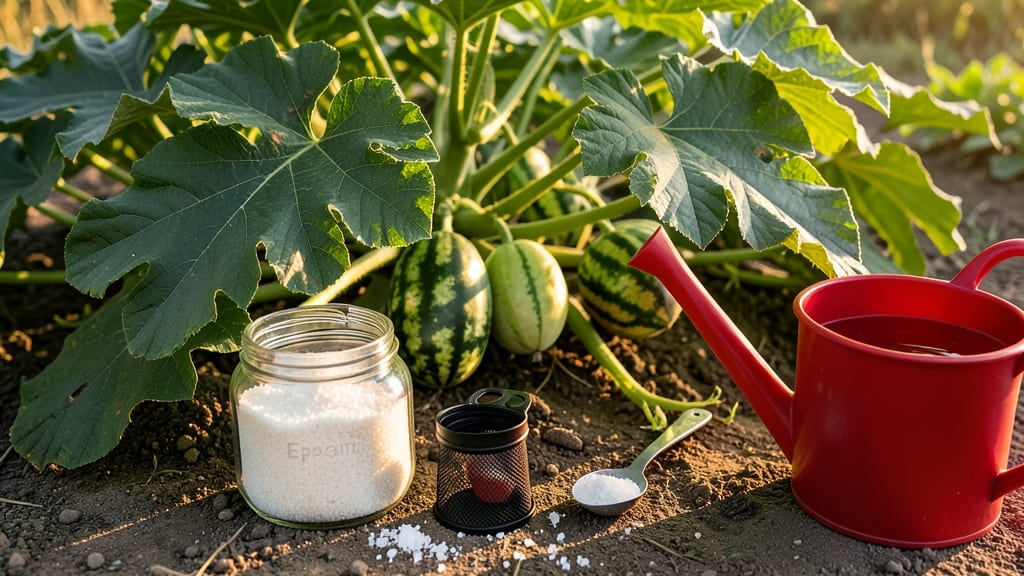
Epsom salt for watermelon plants boosts growth by supplying magnesium and sulfur, which strengthen vines, enhance fruit development, and prevent yellowing leaves from deficiencies. Use it sparingly—1 tablespoon per gallon of water—every 4-6 weeks during the growing season.
Watermelons thrive when their soil has adequate magnesium and sulfur, two key nutrients that Epsom salt provides in an easily absorbable form. 🌱 Magnesium is essential for chlorophyll production, helping leaves convert sunlight into energy, while sulfur supports enzyme activity that fuels growth.
I've noticed that plants treated with Epsom salt develop thicker vines and sweeter fruit, especially when applied during flowering and fruiting stages. The secret is consistency—too little won't show results, but overdoing it can lead to salt buildup in the soil, harming roots over time.
For best results, I recommend mixing the solution in a watering can and applying it directly to the soil at the base of the plant. You can also use it as a foliar spray for faster absorption, but always test on a small leaf area first to check for sensitivity.
Remember, watermelons are heavy feeders, so combining Epsom salt with compost or organic fertilizers creates a balanced nutrient profile that supports both growth and flavor development.
💡 In This Article
- How Magnesium and Sulfur in Epsom Salt Improve Watermelon Growth
- Step-by-Step Guide to Applying Epsom Salt for Watermelons
How magnesium and sulfur in Epsom salt improve watermelon growth
Magnesium acts as the central atom in chlorophyll molecules, which is why its deficiency causes that classic yellowing between leaf veins—called interveinal chlorosis.
In watermelons, this shows up first on older leaves as a pale yellow band along the edges, eventually spreading inward. 🌿 The plant's ability to capture sunlight drops by up to 50% when magnesium levels fall below 0.2%, directly stunting photosynthesis.
Sulfur, meanwhile, plays a critical role in forming amino acids and vitamins that regulate plant metabolism, particularly during fruit development when watermelons need extra energy to sweeten and ripen properly.
Watermelon vines require magnesium to maintain cell wall integrity, which is why treated plants develop thicker stems that can support heavier fruit loads. Studies show magnesium-deficient watermelons produce fruit that's 15-20% lighter and contains fewer natural sugars.
The sweetness gap comes from reduced chlorophyll activity limiting carbohydrate production in the leaves. Sulfur's role in enzyme activation ensures these sugars are properly transported from leaves to developing fruit, creating that signature watermelon sweetness we all love.
What makes Epsom salt particularly effective is its ability to release magnesium in a form plants can absorb immediately through their roots.
Unlike many soil amendments that require microbial breakdown, magnesium sulfate dissolves quickly in water, making it available within hours of application. 💧 This rapid uptake explains why foliar sprays work so well—when applied to leaves, the solution is absorbed through stomata (tiny leaf pores) within minutes, delivering an instant nutrient boost during critical growth stages like flowering.
However, there's a catch: watermelons can only absorb so much magnesium at once. Excessive applications lead to soil pH imbalances, where magnesium ions displace calcium and potassium in the root zone.
This creates a competitive absorption scenario where roots struggle to take up other essential nutrients, even if they're present in the soil. That's why the 1-tablespoon-per-gallon ratio works best—it provides enough magnesium without overwhelming the plant's nutrient uptake system.
For organic gardeners, Epsom salt offers a quick fix, but it shouldn't replace long-term soil building.
Think of it as a vitamin shot for your watermelons—great for correcting deficiencies but not a substitute for healthy soil rich in organic matter. 🌱 The ideal approach combines Epsom salt applications with compost or well-rotted manure to create a balanced nutrient environment where magnesium can work alongside other essential minerals for optimal growth.
Watch for these deficiency signs in your watermelons: yellowing between leaf veins while keeping green along the main veins, stunted vine growth, and small, underdeveloped fruit. These are your plant's SOS signals that it needs magnesium.
The good news? With proper Epsom salt applications, you'll typically see new growth with darker green leaves within 7-10 days, followed by improved fruit development within 3-4 weeks.