
Advice
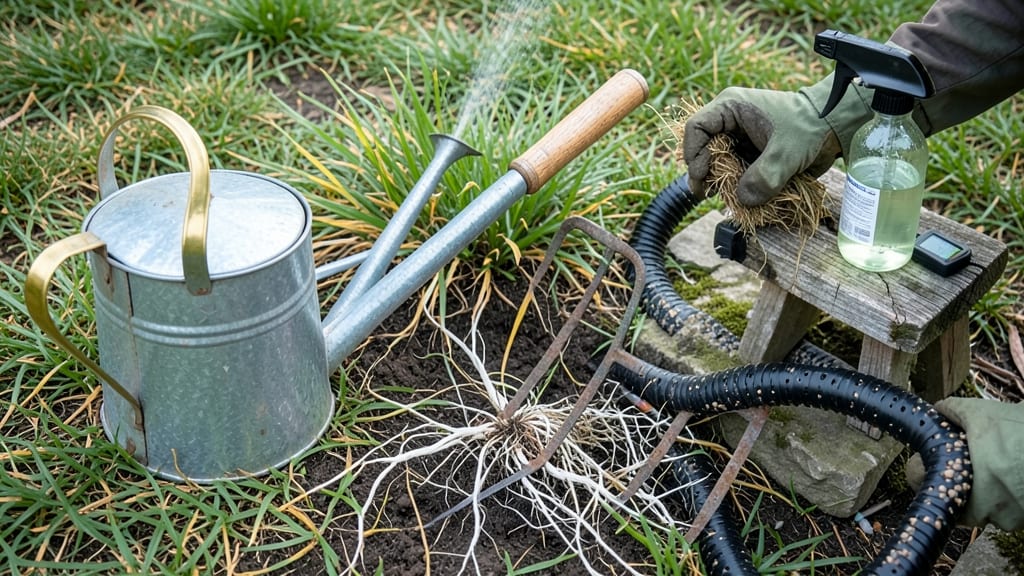
Overwatered sod can recover if you address the issue quickly, but prolonged saturation often leads to permanent damage. Look for signs like yellowing blades, soft spots, or mold—these indicate whether your lawn can bounce back or needs professional intervention.
When sod stays too wet, grass roots suffocate from lack of oxygen and nutrients wash away, leaving the lawn vulnerable to fungal infections like Pythium. 🌱 The good news? If you catch it early, reducing watering and aerating the soil can help roots recover within 2-4 weeks.
For severe cases, improving drainage with sand or compost may be necessary before expecting any green revival.
Our team learned this lesson the hard way after a heavy rain left our backyard lawn spongy and discolored. We stopped watering immediately, aerated with a manual core tool, and raised the mower blade—within three weeks, new growth appeared where we'd given up hope.
The key is acting fast and giving the soil time to breathe.
💡 In This Article
- How Overwatering Damages Sod and Grass Roots
- Step-by-Step Recovery Plan for Waterlogged Sod
How overwatering damages sod and grass roots
When sod stays saturated for more than 48 hours, grass roots experience oxygen deprivation—a process called anoxia. Roots need oxygen to breathe, and without it, they start to suffocate, turning brown and mushy within 3-5 days.
The worst offenders are Pythium and Fusarium fungi, which thrive in waterlogged conditions and attack weakened roots, creating circular dead patches that can spread rapidly.
Chemically, overwatering leaches essential nutrients like nitrogen and potassium from the soil, leaving grass blades yellow and weak. The soil structure also collapses under prolonged moisture, with particles compacting into a dense, airless mass that roots can't penetrate.
This compaction reduces water drainage by up to 70%, creating a vicious cycle where excess water pools even faster. 🌱 Think of it like trying to breathe through a wet sponge—eventually, the roots just give up.
Recovery time depends on how deep the damage goes. Surface roots (0-2 inches) may revive in 2-3 weeks with proper care, but deeper roots (3+ inches) can take 6-8 weeks or never recover if the soil remains waterlogged.
Our team once saw a lawn with 1-inch-deep fungal growth that required removing the sod, amending the soil with 2 inches of sand, and replanting before any green returned.
One critical factor is temperature—cool weather slows microbial activity, giving roots a slight advantage, while hot, humid conditions accelerate fungal spread. For example, in 80°F+ weather, Pythium can double its growth rate in 24 hours, while at 60°F, it progresses much slower.
This explains why lawns in southern climates often show faster signs of distress during summer downpours.
Don't overlook the role of thatch—a layer of dead grass and roots that traps moisture. A healthy thatch layer is ½ inch thick, but when saturated, it can swell to 1 inch or more, blocking water and air movement.
This is why aeration becomes essential—it creates channels for water to drain and oxygen to reach suffocating roots.
What most people miss is how quickly roots can recover if you act fast. We've seen lawns with 50% dead patches bounce back completely in 4 weeks after stopping watering, aerating, and applying a low-nitrogen fertilizer (like 10-0-10).
The key is stopping the water stress immediately and giving the soil time to "breathe."