
Plants
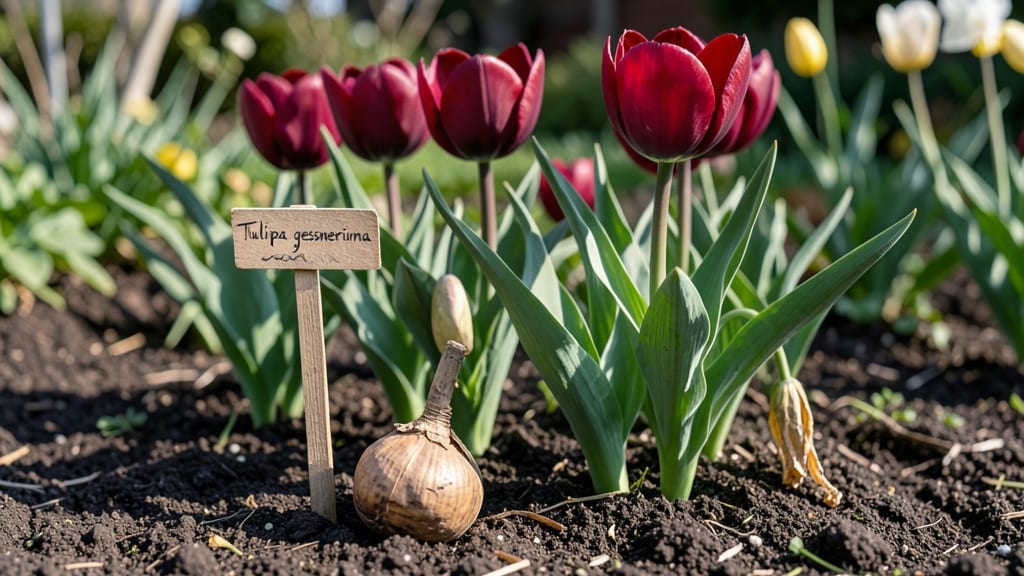
Tulips are perennials because they regrow from the same underground bulbs each year, but their above-ground foliage dies back completely after blooming—making them look like annuals in most gardens.
This dieback isn't a sign of death—it's how tulips conserve energy in their bulbs for next season. 🌱 In ideal conditions, a single bulb can produce flowers for 3-5 years or more, though many gardeners mistakenly assume they're annuals because they don't see new growth until spring.
The key difference between true annuals and tulips is that annuals complete their entire life cycle in one season, while tulips rely on stored energy in their bulbs to regenerate year after year.
What sets tulips apart is their ability to store nutrients underground while appearing dormant above ground. This adaptation allows them to thrive in temperate climates where winters force plants into dormancy.
The misconception comes from how gardeners often remove dead foliage too early, starving the bulb of the energy it needs to bloom again next year.
💡 In This Article
- Why Tulips Appear to Die Each Year
- How to Encourage Long-Term Tulip Growth
Why tulips appear to die each year
Tulips undergo a natural process called senescence after blooming, where their above-ground stems and leaves yellow and wither. This isn't death—it's how the plant redirects all its energy into the underground bulb, which acts like a living battery.
During the growing season, the bulb stores carbohydrates (like starch) and nutrients produced by photosynthesis in the foliage. When the leaves die back, they've already transferred most of their stored energy to the bulb, preparing it for dormancy.
The bulb's role is critical: it contains meristematic cells—undifferentiated cells that can regenerate new shoots when conditions are right. In temperate climates, these bulbs enter dormancy during winter, a survival mechanism that conserves energy until spring warmth triggers regrowth.
Unlike true annuals, which complete their entire life cycle in one season, tulips rely on this stored energy to push up new shoots year after year. 🌱 This is why gardeners often mistake tulips for annuals—they disappear above ground but remain alive below.
What makes this process fascinating is the timing: tulips begin storing energy in their bulbs as soon as the flower opens. If you remove the foliage too early (within 4-6 weeks after blooming), the bulb won't have enough time to replenish its reserves.
This is why many gardeners see fewer blooms each year—the bulbs are gradually depleted. In ideal conditions, a healthy tulip bulb can live for 5-10 years, but poor care can shorten this lifespan dramatically.
Here's the science behind it: tulip bulbs contain anthocyanins—the same pigments that give flowers their vibrant colors—which also help protect the bulb from UV damage during dormancy. The bulb's outer scales act as a natural barrier, preventing moisture loss and protecting the delicate meristem.
This adaptation is why tulips thrive in regions with cold winters and warm summers, like the Netherlands or the Pacific Northwest, where they've been cultivated for centuries.
Consider this comparison: a dahlia, another perennial, dies back to the ground but leaves a tuber or rhizome that stores energy. Tulips, however, rely entirely on their bulb—a structure that's both a storage organ and a reproductive organ.
When you see tulips blooming year after year in the same spot, you're witnessing the power of this underground survival strategy. The key takeaway is that the dieback isn't a sign of failure—it's part of the plant's life cycle, carefully timed to ensure survival. 💫
What most gardeners don't realize is that the bulb's size directly correlates with next year's bloom quality. A bulb that's 2 inches in diameter (about the size of a golf ball) will produce a larger, more robust flower than a smaller one.
This is why professional bulb growers focus on bulb division—separating offset bulbs to prevent overcrowding and ensure each has enough resources to thrive.