
Plants
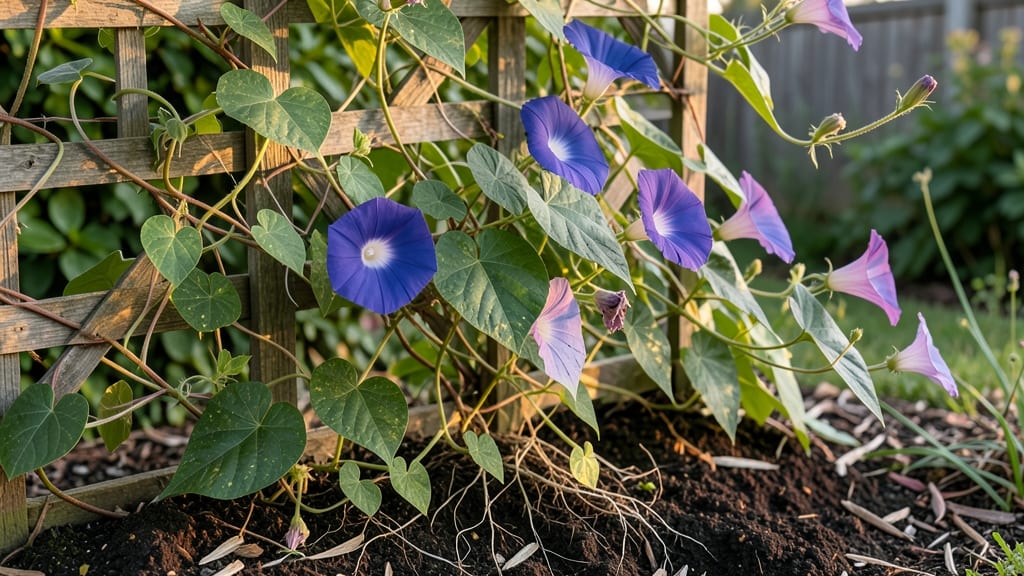
Morning glories are not true perennials in most climates—they die back to the ground after frost but regrow from seeds each spring. In warmer zones (USDA 8-11), they may self-seed aggressively or persist as annuals with winter dieback, depending on temperature and moisture levels.
Most gardeners treat morning glories as annuals because their aboveground growth freezes in winter, but their survival strategy depends on where you live. 🌱 In colder regions, they rely entirely on seeds dropped from spent blooms, which need warm soil to sprout again.
Meanwhile, in frost-free zones, some varieties might linger as semi-perennial vines, though they still slow down dramatically in cooler months. The key difference lies in how your climate interacts with their natural dormancy cycle—think of them as "seasonal reseeders" rather than hardy perennials.
Understanding this behavior helps explain why morning glories often return year after year without replanting: their lightweight seeds spread easily, and many varieties produce hundreds of them. However, this self-sowing habit can become invasive if not managed properly.
The plant's ability to bounce back each spring makes it feel perennial-like, even though botanically it's classified differently. For gardeners in transitional zones (USDA 7-8), the line between annual and perennial behavior can blur completely.
💡 In This Article
- Why Morning Glories Die Back in Cold Climates
- How to Grow Morning Glories as Repeat-Blooming Annuals
Why morning glories die back in cold climates
Morning glories (Ipomoea spp.) lack true perennial structures like woody stems or deep root systems that survive freezing temperatures. Their aboveground growth consists of tender, herbaceous vines that contain up to 80-90% water—a composition that makes them extremely frost-sensitive.
When temperatures drop below 28°F, cellular membranes rupture, causing irreversible damage within hours. This is why most varieties collapse completely after the first hard frost, even in regions where they thrive during summer months.
The plant's survival strategy shifts entirely to seed production. Throughout the growing season, morning glories develop 300-500 seeds per vine (depending on variety), which are lightweight and easily dispersed by wind or wildlife. These seeds remain dormant until soil temperatures reach 60-65°F, triggering germination.
In colder climates, this means new plants only emerge when daytime highs consistently exceed 70°F for several days—a process that can take 4-6 weeks after frost thaw.
What makes this cycle fascinating is the plant's ability to time its dormancy perfectly. Morning glories contain abscisic acid, a hormone that signals dormancy in response to shortening daylight hours and cooling temperatures.
This biochemical trigger explains why vines yellow and die back so abruptly in fall—it's not just cold damage, but an active survival mechanism. The seeds themselves have a 3-5 year viability in optimal conditions, which is why morning glories often return year after year without replanting.
In warmer climates (USDA zones 8-11), the story changes slightly. Some varieties develop slightly thicker stems and may produce tuberous rootlets that store minimal carbohydrates, allowing them to persist through mild winters.
However, these aren't true tubers like sweet potatoes—they're more like swollen root nodes containing just enough energy for 2-3 weeks of regrowth in spring. This explains why morning glories in these zones often appear "perennial-like" but still require seed-based regeneration for full vigor.
Here's where it gets technical: morning glories exhibit thermoperiodism, meaning their growth responds to both air and soil temperatures. Research shows that seeds won't germinate until soil temperatures exceed 60°F for 24+ hours, while vines stop growing when nighttime temperatures fall below 55°F.
This dual temperature sensitivity explains why morning glories often bloom in waves—new growth emerges only when both conditions are met simultaneously.
For gardeners in transitional zones (USDA 7-8), the plant's behavior can be particularly confusing.
A 2018 study in HortScience found that morning glories in these areas may produce 50% fewer seeds than in warmer climates, but the seeds that do form are 20% larger—likely an evolutionary adaptation to improve survival odds in cooler conditions.
This explains why some gardeners swear their morning glories return every year, while others struggle to get them to reappear.