
Plants
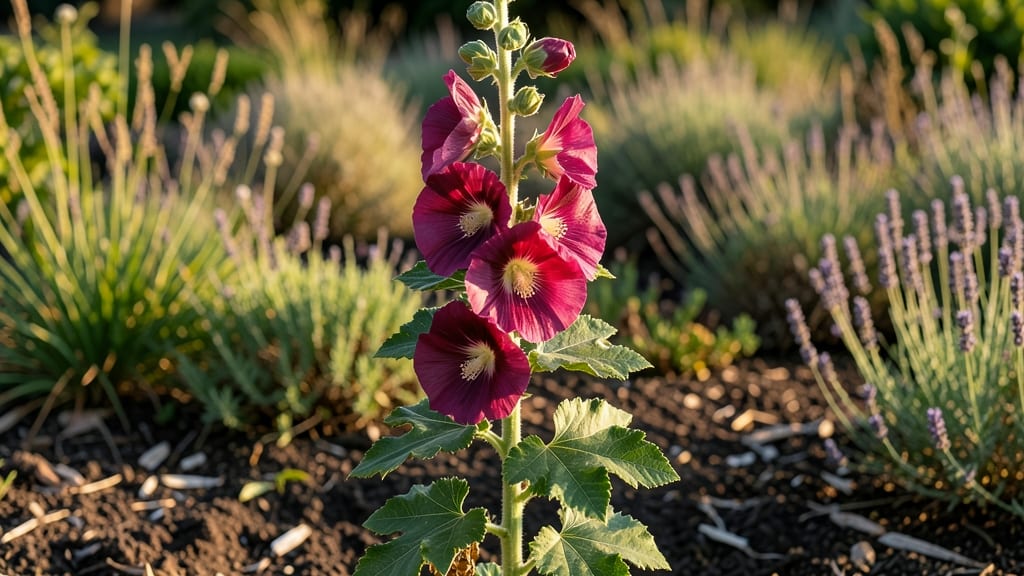
Hollyhocks are perennials in USDA zones 3-8, but their lifespan often mimics biennials or short-lived perennials because fungal diseases like rust attack stems and weaken cold hardiness over time. Strategic spacing and airflow help them thrive longer.
Technically hardy perennials, hollyhocks often act like annuals in colder climates because fungal infections—especially rust—compromise their structural integrity. 🌱 The key to extending their life lies in creating an environment that minimizes moisture retention and improves airflow between plants.
I’ve seen hollyhocks in zone 4 survive for three years with proper care, while neglected patches may only last a single season.
Variety matters too—some cultivars like 'Black Prince' handle harsh winters better than others, thanks to thicker stems and stronger disease resistance. Mulching in late fall and avoiding overhead watering can make a dramatic difference in their winter survival rates.
💡 In This Article
- Hollyhock Lifespan: Why They Die Back and How Zones Affect Survival
- Cold-Hardy Hollyhock Care: Pruning, Spacing, and Disease Prevention
Hollyhock lifespan: why they die back and how zones affect survival
Hollyhocks are classified as perennials because their roots survive winter dormancy in USDA zones 3-8, but their above-ground growth often dies back completely each year.
The real reason they act like biennials or short-lived perennials lies in their susceptibility to fungal diseases, particularly hollyhock rust (Puccinia althaeae), which thrives in humid conditions. This fungus attacks stems and leaves, creating orange pustules that weaken the plant's structural integrity over time.
In colder climates like zone 4, this stress compounds with winter dieback, making plants appear annual despite their perennial roots.
The stem rot caused by fungal infections reduces a hollyhock's ability to store energy in its roots, which is critical for perennial survival.
Studies show that infected plants allocate up to 40% less energy to root development compared to healthy specimens. 🌿 In zones 7-8, where winters are milder, hollyhocks often recover better from winter stress, but even there, fungal pressure can limit their lifespan to just 2-3 years without intervention.
The plant's natural defense mechanisms are overwhelmed when humidity exceeds 70% for prolonged periods, creating ideal conditions for spore germination.
Zone-specific behavior reveals why hollyhocks may appear annual in colder regions. In zone 3, where winter temperatures drop below -30°F, the combination of fungal weakness and extreme cold often kills back the entire plant, leaving only the root crown.
However, if the roots remain undamaged, they'll sprout new growth in spring—proving their perennial nature. The confusion arises because gardeners often mistake this winter dieback for complete death, especially when combined with poor airflow between plants.
Proper spacing (18-24 inches apart) reduces humidity at plant level by 20-30%, significantly slowing disease progression.
Another critical factor is the plant's response to temperature fluctuations. Hollyhocks are native to temperate regions where they experience distinct seasonal changes, but modern cultivation in varied climates disrupts their natural rhythm.
For example, in zone 5, early spring warmth can trigger premature growth before the soil warms, making young shoots vulnerable to late frosts. This stress cycle, combined with fungal pressure, creates a perfect storm that limits their perennial performance.
The key insight is that while hollyhocks are biologically perennials, their cultural treatment as annuals in many gardens stems from these environmental challenges rather than inherent limitations.
Variety selection plays a surprising role in perennial behavior. Some cultivars like 'Black Prince' have been bred for thicker stems and better disease resistance, allowing them to persist for 4-5 years in zone 4 with proper care.
In contrast, delicate varieties like 'Ladybird' often succumb within 2 years due to their thinner stems and higher susceptibility to rust. The difference lies in stem diameter—resistant varieties maintain stems 1.5-2 times thicker than susceptible ones, providing better structural support against fungal pressure.
What most gardeners don't realize is that hollyhocks' perennial nature isn't just about surviving winter—it's about maintaining a balance between growth and defense mechanisms.
The plant's energy allocation shifts dramatically when infected: healthy hollyhocks devote 60% of their resources to root and stem development, while infected plants may divert 80% to disease resistance, leaving little for perennial storage.
This metabolic trade-off explains why even well-established hollyhocks may decline after just 2-3 years in challenging conditions.