
Vegetables
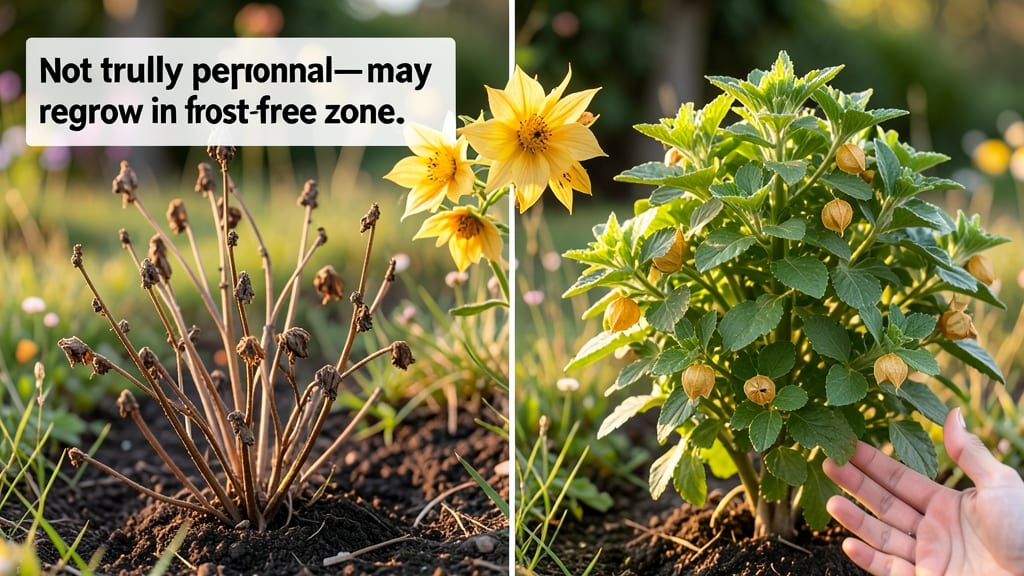
Ground cherries aren't true perennials in most growing zones, even though they may resprout from the base each spring if frost isn't severe. Their above-ground growth dies back completely each winter, but the roots survive in mild climates, creating the illusion of perennial behavior.
This "false perennial" behavior happens because ground cherries are actually tender perennials—their roots can live for years in frost-free zones (like zones 8-11), but cold snaps kill the stems. 🌱 The confusion comes from seeing new shoots emerge each spring, which tricks gardeners into thinking they're hardy like blueberries or asparagus.
In reality, they're more like strawberries: technically perennials but requiring annual care to thrive.
What makes this interesting is how their growth habit differs from true perennials. Most perennials like peonies or hostas have woody crowns that survive winter intact, while ground cherries rely entirely on their root systems to regenerate.
This makes them more delicate—one hard freeze can kill them completely in colder regions.
💡 In This Article
- Ground Cherry Plant Lifespan: Why They Die Back Annually
- How to Overwinter Ground Cherries for Year-Round Growth
Ground cherry plant lifespan: why they die back annually
Ground cherries behave like tender perennials because their root systems remain dormant but viable through winter, even when above-ground growth dies back completely.
The key mechanism is cold-induced dormancy: when temperatures drop below 32°F, the plant's stems and leaves blacken and collapse, but the roots stay alive in the soil.
This happens because ground cherry roots contain reserve carbohydrates stored in their thickened root crowns, which fuel regrowth when spring warmth returns.
The confusion arises because their regrowth pattern mimics true perennials like strawberries or asparagus, but with critical differences.
Unlike these plants, ground cherries lack woody stems that persist through winter—their stems are herbaceous and freeze solid. 🌱 In warmer climates (zones 8-11), roots can survive for 3-5 years, producing new shoots annually, while in colder zones (below 7), they typically die back completely each winter unless protected.
What sets ground cherries apart is their ephemeral aboveground growth. Their stems are non-woody and non-lignified, meaning they lack the protective bark found in true perennials.
This makes them vulnerable to frost damage—even a single hard freeze (20°F) can kill the entire plant back to the ground. The root system's survival depends on soil insulation and moisture retention, which is why mulching becomes crucial in marginal climates.
Botanically, ground cherries belong to the Solanaceae family (like tomatoes and potatoes), which are mostly annuals or tender perennials. Their perennial-like behavior stems from geographical adaptation: native to South America, they evolved in regions with mild winters where roots could persist.
This explains why they thrive in Mediterranean climates but struggle in northern gardens without winter protection.
Consider this comparison: while blueberries (true perennials) have woody canes that survive winter, ground cherries rely entirely on root regeneration. Their shoots emerge from the crown buds at the soil line, similar to how strawberries produce new fronds each spring—but without the same cold hardiness.
This makes them semi-perennial in nature, a category that includes plants like ginger or turmeric, which die back annually but regrow from rhizomes.
The takeaway is that ground cherries aren't "failing" to be perennials—they're following a different survival strategy. Their root systems act like biological batteries, storing energy to restart growth when conditions improve.
This is why gardeners in USDA zones 8-11 can often harvest fruit for multiple seasons from the same plant, while those in colder zones may need to treat them as short-lived perennials** or annuals.