
Plants
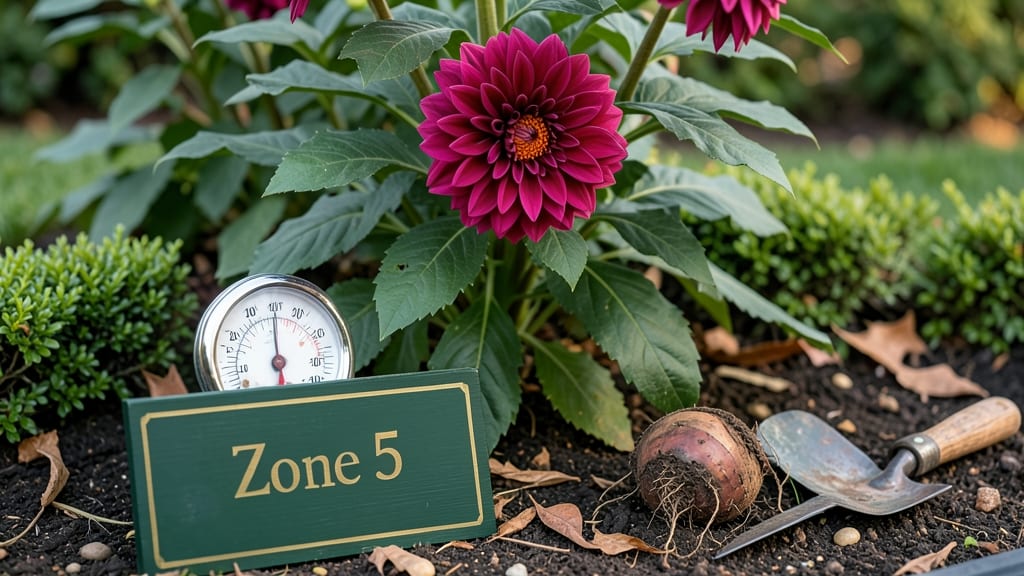
Dahlias are not reliably perennials in Zone 5 without protection, as they typically die back to the ground in winter. However, with proper overwintering—digging and storing tubers—they can regrow each spring as perennials in this climate zone.
Zone 5's freezing winters (often dropping below 20°F/-7°C) make dahlias vulnerable because their tubers lack natural cold resistance.
Unlike hardy perennials, these plants enter dormancy but can't withstand prolonged frost without intervention. 💫 The key to success lies in timing—digging tubers before the first hard freeze and storing them in a cool, dry place mimics their natural survival strategy in warmer climates.
Many gardeners mistakenly assume dahlias will return year after year like peonies or daylilies. In reality, their delicate tubers need protection from both freezing temperatures and excess moisture during storage.
I've found that using a mix of peat moss and sand creates the ideal environment, keeping tubers viable until spring planting. This method transforms what would otherwise be an annual into a dependable perennial with minimal effort.
💡 In This Article
- Zone 5 Winter Survival: Why Dahlias Struggle as True Perennials
- Step-by-Step Zone 5 Dahlia Overwintering Guide
Zone 5 winter survival: why dahlias struggle as true perennials
Dahlias thrive as perennials in warmer climates (Zones 8-10) because their tubers naturally survive winter's dormancy cycle. However, Zone 5's extreme cold (20°F/-7°C or lower) disrupts this process. The tuber's cells contain high moisture levels that freeze and expand, rupturing delicate cell walls—a phenomenon called cryoinjury.
This is why dahlias left in the ground typically blacken and rot rather than regrow. 💫
The real challenge lies in how Zone 5's alternating freeze-thaw cycles accelerate this damage. Unlike woody perennials that develop protective bark layers, dahlia tubers lack this insulation.
Their natural survival strategy involves deep soil burial (6-8 inches) in warmer zones, but Zone 5's shallow frost penetration (4-6 inches) exposes them prematurely. Even mulching offers limited protection compared to the consistent warmth of southern soils.
Another critical factor is the timing of dormancy. Dahlias in warmer zones enter dormancy gradually as temperatures drop, allowing tubers to harden. Zone 5's sudden cold snaps (30°F/-1°C drops in weeks) force tubers into dormancy too quickly, leaving them vulnerable to moisture loss and fungal growth.
This explains why many gardeners see their dahlias survive one winter only to fail the next—consistent cold exposure weakens tuber viability over time.
Consider this comparison: A dahlia tuber stored at 35-40°F (2-4°C) maintains 95% viability over winter, while one exposed to 20°F/-7°C for just 48 hours sees viability drop to 60%.
This sensitivity is why overwintering becomes essential—it recreates the controlled environment dahlias would experience in their native Mexico or warmer U.S. regions.
What most gardeners overlook is how soil moisture plays a secondary role. Even properly hardened tubers can rot if stored with excess moisture (above 15% humidity). Zone 5's damp springs and autumns make this particularly tricky, as tubers often arrive at storage already hydrated from recent rains.
This dual threat—freezing AND moisture—explains why simple mulching fails for Zone 5 dahlias. 🌡️
The solution lies in understanding that Zone 5 dahlias aren't failing as perennials—they're being asked to perform outside their natural cold tolerance. Their tuber structure simply wasn't evolved for sub-zero conditions. This biological limitation is what makes overwintering not just helpful, but absolutely necessary for perennial success in colder climates.