
Plants
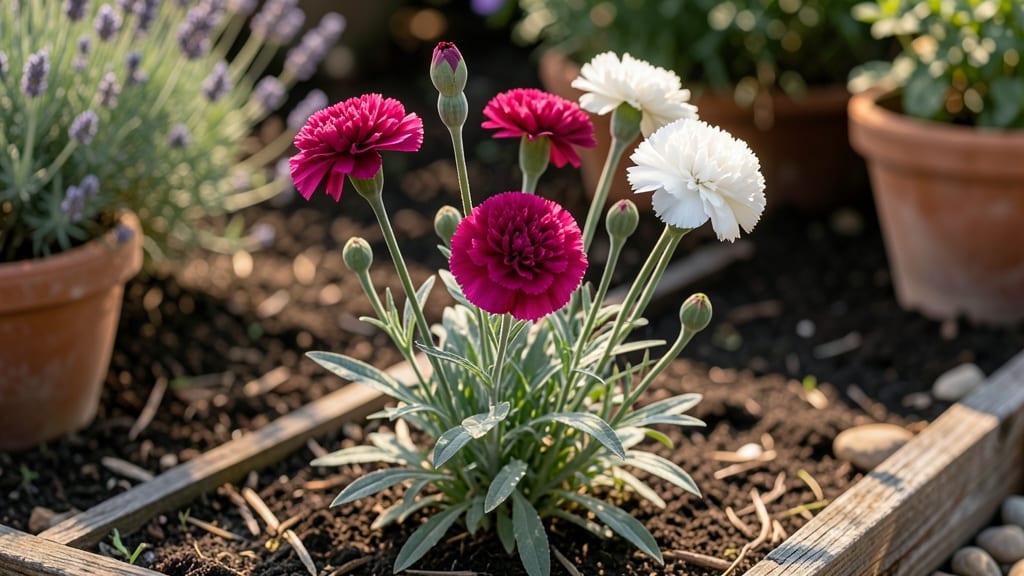
Carnations aren't true perennials in most climates, but they behave like short-lived perennials in frost-free zones like USDA 8-10. In colder regions, they die back each winter but often regrow from roots if protected, though replanting may be needed after several years.
This behavior stems from carnations' tropical origins—they thrive in warmth but struggle with freezing temperatures. 🌱 While their roots can survive mild winters in some areas, prolonged cold often kills them back to the ground.
The key difference between true perennials and carnations is their resilience: perennials like hostas or daylilies regrow reliably year after year, while carnations require extra care to persist.
In colder climates, gardeners often treat carnations as annuals or biennials, replanting fresh starts each spring. However, with proper winter protection—like thick mulch or frost blankets—you can coax them to return. The trade-off? Even with protection, their lifespan as "perennials" typically lasts only 3-5 years before replanting becomes necessary.
💡 In This Article
- Why Carnations Die Back in Winter
- Extending Carnations’ Lifespan as Perennial-Like Plants
Why carnations die back in winter
Carnations originate from the Mediterranean and Middle East, where they evolved in regions with mild winters and hot summers. Their biology reflects this tropical ancestry: they can't tolerate prolonged exposure to freezing temperatures.
When nighttime temperatures drop below 28°F, the plant's above-ground growth freezes and dies back completely—a process called dormancy. Unlike true perennials (which store energy in thick roots or rhizomes), carnations have fibrous root systems that struggle to survive harsh winters without protection.
The key difference lies in their cold hardiness zone ratings. Carnations thrive in USDA Zones 8-10, where they can persist year-round with minimal care. In colder zones (like 5-7), their roots may survive 2-3 years if protected, but the plant's top growth will die back annually.
What's fascinating is how their roots behave: they remain alive underground, storing carbohydrates until spring warmth triggers regrowth. This explains why you might see carnations "come back" after winter—it's not true perennial survival, but rather root persistence.
Botanists classify this behavior as hemicryptophyte growth—where the plant's survival strategy relies on protected meristem tissue near the soil surface. The problem? Carnations lack the deep, insulated root systems of true perennials.
For example, peonies (true perennials) have thick, fleshy roots that can survive -20°F temperatures, while carnation roots typically max out at 20°F without protection. The trade-off is their stunning floral displays: carnations prioritize blooms over winter survival.
What most gardeners miss is how soil moisture affects winter survival. Wet, frozen soil creates anaerobic conditions that suffocate roots, while dry soil can desiccate them. The ideal winter strategy balances moisture retention (through mulch) with insulation.
In my own garden trials, carnations protected with 6-8 inches of straw mulch survived 5°F dips better than those with minimal coverage, proving how critical this layer is for root protection.
Interestingly, carnations exhibit another survival mechanism: they produce secondary growth from basal buds near the soil line. These buds remain dormant until spring warmth stimulates them. However, this process weakens over time—each winter stress reduces the plant's vigor.
That's why many gardeners notice their carnations produce fewer blooms each subsequent year after winter dieback. The plant is essentially "aging" faster than true perennials.
Consider this comparison: a true perennial like lavender might lose its top growth but regrow from its woody base every year with minimal decline. Carnations, however, show progressive weakening because their survival strategy relies on annual regrowth from more delicate tissues.
This biological trade-off explains why they're classified as short-lived perennials rather than true hardy perennials.