
Plants
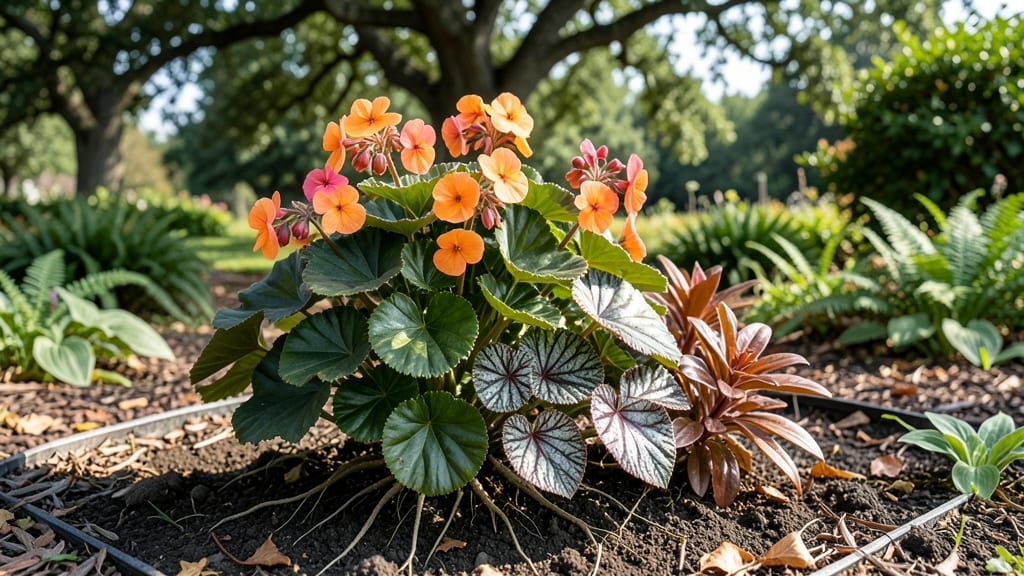
Begonias act as perennials in frost-free regions (USDA Zones 10-12) but behave like annuals in cooler climates, losing foliage each year. Their underground roots or tubers survive winter dormancy when protected from freezing temperatures.
This behavior comes down to their natural growing patterns. 🌱 In warmer zones, begonias thrive year-round, producing new growth from their roots or tubers after winter dormancy.
However, when temperatures dip below 30°F, the above-ground parts die back completely—this is why gardeners in cooler areas often replant them each spring. The key difference lies in their root systems: tuberous begonias store energy underground, while fibrous-rooted types rely on consistent warmth to regenerate foliage.
For gardeners in Zones 7-9, this means strategic planning. Many choose to dig up tubers in fall and store them indoors until spring, effectively extending their lifespan beyond a single season. This approach turns what appears to be an annual into a long-lived perennial with proper care.
💡 In This Article
- Begonia Cold Hardiness Zones and Frost Sensitivity
- Overwintering Begonias in Cooler Climates
Begonia cold hardiness zones and frost sensitivity
Begonias' perennial nature hinges on their ability to survive winter through underground storage organs rather than persistent foliage. In USDA Zones 10-12, where winter temperatures rarely drop below 30°F, begonias naturally enter dormancy but their fibrous roots or tubers remain alive beneath the soil.
This underground survival mechanism is what classifies them as perennials in frost-free regions, where they regenerate foliage each spring from these protected structures.
The critical threshold for begonia survival is 32°F, where above-ground growth begins to suffer irreversible damage. At 28°F, even the hardiest varieties like Begonia grandis will experience complete foliage dieback, though their roots may still survive if protected.
This frost sensitivity explains why gardeners in Zones 7-9 often treat begonias as annuals—they simply can't withstand prolonged exposure to freezing temperatures without intervention. 🌡️ The science lies in cellular dehydration: as temperatures drop, water within plant cells crystallizes, rupturing cell membranes and killing foliage.
What makes begonias unique is their two distinct root systems that influence survival strategies. Tuberous begonias store energy in thickened underground stems (tubers) that can remain dormant for months, while fibrous-rooted types rely on a network of fine roots that regenerate quickly in warm conditions.
This biological difference means tuberous varieties have a better chance of overwintering successfully in marginal zones (like Zone 9) with proper protection, while fibrous-rooted types require more consistent warmth to survive.
Zone-specific behavior patterns reveal fascinating adaptations. In Zone 10, begonias may show partial dieback during rare cold snaps but recover fully, demonstrating their true perennial nature.
By contrast, in Zone 8, even a single night below 25°F can kill foliage completely, forcing gardeners to either dig up tubers or accept annual replanting.
The transition between these behaviors occurs gradually across zones, with Zone 9 serving as the critical battleground where proper winter care can tip the balance from annual to perennial performance.
Temperature isn't the only factor—soil moisture and wind exposure play supporting roles. Dry soil conducts cold more efficiently, accelerating damage, while wind desiccates tender foliage.
This is why mulching with 3-4 inches of organic material (like straw) becomes crucial in marginal zones—it insulates roots and maintains soil temperature fluctuations within a survivable range.
The interplay between these environmental factors explains why begonias might thrive as perennials in one garden but fail completely just a few miles away with different microclimates.
Understanding these mechanisms helps gardeners make informed choices. For example, selecting Begonia semperflorens (a fibrous-rooted type) in Zone 10 ensures reliable perennial performance, while choosing Begonia tuberhybrida in Zone 8 requires active overwintering strategies.
The key insight is that begonias' perennial status isn't absolute—it's a dynamic relationship between the plant's biology and its growing environment. 🌱